My father-in-law’s memorial service was Saturday, over a month after his death. It was a nice service, although long – nearly 2 hours. The day had started early, with my husband leaving about 9 am to try to get some time with his siblings to hand off family paperwork. The kids and I were going to follow, leaving shortly after noon, for the private inurnment at 2. I got a call at 11:40, letting me know the inurnment was going to be at 1 pm instead. And, we were off, with another inevitable series of miscues from my husband’s side of the family.
My family was always prompt. If we were invited for dinner at 8 and drinks at 6:30, we were there at 6:23, no later than 6:35 without a phone call. If we were going to a wedding at 2, we usually arrived early enough to get into the church without lunging through the wedding party to do so, and didn’t stay too long at the reception. We’d toast the bride, talk to a few acquaintances, if any, make new friends if no old ones were there, and leave after the first couple of dances. We always had something else to do, even if it was just going back to our hotel room to take off our shoes, or go out to dinner, or whatever.
My stepmother had an excellent sense of timing and social poise. If she caught herself spending too much time rambling on (or being rambled at) about “old times,” she’d excuse herself and go touch bases with my Dad, move to another clump of people to mingle, check on me to make sure I was enjoying myself, etc. She was an excellent hostess and a superb guest. I’d like to say I take after her in that way, but sometimes I just get fed up and go hang out in the bathroom if I’m really bored.
It’s been hard to adjust to my in-laws. They are not only chronically late; they are often criminally late. We had a house-warming ten years ago, when we moved here. My husband was so proud of our new, big house. He invited some other relatives who live in the area, he ordered catered food in, we scrubbed and cleaned and dusted, the kids were on their best behavior. We had a great time with the nearby relatives. Then they left. Four hours after the housewarming started, his parents and siblings showed up. We were out of our party clothes, the kids were on to doing other things, the food was cold and on the verge of being put away, and I had left to do other things. They then stayed for 5 hours. My husband was mortified, and his family of origin couldn’t understand why. This was, and is, normal behavior for them.
As if that weren’t bad enough, at every gathering they attend, Christmas, Easter, weddings, and funerals, his parents and siblings clump together like overcooked rice, speaking only to people they’ve known for years and years and with whom they can reminisce. If I am there also, it’s like attending someone else’s high school reunion – I don’t know anyone else there, they clot together and completely exclude spouses, offspring, or anyone else who was not there for the time about which they are heartily reminiscing. They are utterly surprised that any “outsider” would be bored to tears by listening to them hee-haw for 40 minutes about a time they went camping together and so-and-so ate a bug. Sometimes, if there are enough castoff spouses and kids, we go do something on our collective own, and an hour or so later, the clumpers wander over to us and accuse us of being anti-social. I love projection. It makes life so damned hilarious!
I have learned to avoid these gatherings unless I know there are going to be a preponderance of people with better social skills there. That probably sounds nasty, but I’ve had decades now of sitting on a couch, having my conversational sallies and witty retorts either ignored or treated as bizarre. It is very peculiar to me, as I am a welcome guest in many other venues. I get along great with crowds of strangers, in gatherings for my side of the family, at events for my children; I am one of those people who make friends in the line at the grocery store. I just don’t have problems socially, particularly not if I exert myself. Around my spouse’s family, though, you’d think I was wearing a Hooters shirt and a beer can hat, farting out the national anthem. So, I don’t go unless I feel obliged to do so.
During the period between the inurnment and the memorial service, the kids and I tried. But, we don’t remember when so-and-so ate a bug, and it means nothing to us. We didn’t take music lessons with X, have no idea what Y looked like with braces, and none of us ever attended Large Suburban High School, so we have no stories to tell about the principal or any of the teachers, and we really couldn’t care less. After 20 minutes or so, the kids’ eyes started to glaze over, my back hurt, and we were all bored stiff. I gave them permission to go get their Gameboys and books and told them to meet me in the garden. We read and talked and waited another 20 minutes until the service was about to begin and attended that.
Afterwards, another 2 hours of “receiving” time was scheduled, but we had had enough. Enough rudeness, enough being excluded, enough of living with my father-in-law’s dying and death, which we’ve all been parties to, 24 hours a day, for the last two months, as my husband sorts through a half-century of paper, makes and receives long distance phone calls, and talks his mother through using her TV and VCR over and over again. We said our good-byes as quickly as we could, scampered out to the car, loosened ties, changed shoes, turned up the radio, and blew out of the parking lot like we were teenagers leaving the prom. We grabbed dinner on the way home, talked up a storm in the car, and were glad as heck to be home. We were glad to be back somewhere where we matter to everyone else there. We were glad to have a few minutes untainted by the death of someone we really only knew marginally.
My husband arrived 7 hours later, evil-tempered, mean and nasty, the way he always is after spending time with his birth family. I have tried, in the past, to talk to him about it, but I always wind up being wrong, even if I’m not; insensitive, even if I’m not; in short, his crappy moods are somehow always my fault, especially when they’re not. So, I feigned sleep.
It’s times like this when 25 years seems like 24 11/12ths too long. I know it’ll blow over; we’ll go back to getting along as well as we can during this intensified period of his midlife crisis. Maybe there will be some talking, some changes, some improvements, some insight. I don’t know. When it gets like this, I’ve really got to take it one day, one hour, at a time, and I need to do what I can to keep myself and the kids happy. I’m sure I’ve had my shitty days, too, days when I was just too prickly to get along with, too short-tempered to be around, days when I needed to take myself out to the woodshed and have some words with Me. Far more than I can remember, too, most likely.
Knowing that, though, doesn’t make these very long days any shorter; it just makes it possible to have faith in tomorrow. And I remember the phrase I once heard:
“On good days, I am committed to my spouse; on bad days, I’m committed to my marriage; and on very bad days, I’m committed to my promise.”
… … … … …
Then again, in the words of a former boyfriend, “What do you care; they’re just jerks!” Enough wallowing! Ha! Knitting! Strange dinners! Loud music and bad jokes! Onward, ho!
Monday, July 31, 2006


DEAD WORD OF THE DAY
skenchback: having stong personal or family characteristics; remarkable in appearance; easily recognizable
(from The Word Museum by Jeffrey Kacirk)
(from The Word Museum by Jeffrey Kacirk)
Friday, July 28, 2006
Five Things I've Noticed in Other People's Blogs
Five Things I’ve Noticed While
Reading Other People’s Blogs
1. They all have much cleaner/nicer houses than I do. Mostly it’s the pictures of sanitized rooms with pristine white slipcovers or comforters and white carpet that have me convinced of this, but sometimes it’s the text where someone or another discusses how a splotch of something ruined their mornings. I would give my left ear to walk into my kitchen and only notice a splotch. Most mornings I walk into my kitchen, praying on my way there that the refrigerator will have remained shut all night, thereby performing its function of preserving the food therein.
There’s a hole in my aged linoleum, and, god only knows why, it’s mysteriously stained blue in front of the dishwasher from when the NEW dishwasher was constantly vomiting wash water onto the floor; the fronts of the cabinets have stains, not drips, on them, the stove exhaust hood wasn’t spotless when we moved here, and it hasn’t gotten any better (although it hasn’t gotten much worse, either, I do have SOME standards), and there is inevitably a collection of dropped dishtowels on the floor, along with bits of trash that missed the can when they were thrown in that general direction, bird fluff and seeds, food from when the Labrador decides it no longer belongs in the bowl, plenty of dust, sticky blobs on the counter, crap in the sink, and a fine, protective layer of dog hair on pretty much everything. I swear, on my favorite Auntie’s grave, it looked much better when I went to bed.
And that’s just the kitchen. Heaven forbid we discuss other rooms. I think I am the only person in America who has the joy of having a digital camera, a blog, and a cluttered and lived-in house.
…I am NOT taking any pictures of it to prove it to you!
2. Their furniture and gardens are better/tidier, too. Everybody with a blog can afford new furniture. I did not know this was a requirement when I started my blog. I will probably be retroactively sent to the basement to wash smelly diapers in perpetuity in order to atone for my sin of presumption.
We lived on borrowed, found, thrift shop, or garage sale furniture exclusively for the first decade of our marriage. Orange couches, really awful plaid armchairs, coffee tables scrounged, refinished and fixed up, and some relative’s discarded bed made up our “shabby, not-so-chic” décor. There was a hidden bonus to our cruddy furnishings, though, I really didn’t care if the babies threw up or smeared grape jelly on it. I cleaned messes up, sure, but I had no financial or emotional investment in any of it. Things are marginally better now, what with a few pieces of new (extremely durable and stain resistant) stuff I’ve bought within the last 5 years and a better grade of crap overall, but still…
Gardens? Where are the pictures of marigolds skeletonized by earwigs? The fountains with bird poop on them, the yards with bald patches and ordinary kid pools in them? How about misaligned badminton nets, basketball hoops that are slightly askew, and a tall, healthy thistle plant amongst the struggling roses? On my damn blog and nowhere else. “Welcome ladies and germs to the only website showing you a REAL typical American yard!” Aaargh.
3. It is easier to despise than to admire. I have read a lot of snooty blogs that disparage other people’s blog’s failings. I have probably fallen into that trap myself, but I am putting a sticky note on my computer to “look for the positive” if I talk about another person’s blog. I admit to envy, sarcasm, and an excess of bad humor. I am trying desperately to avoid commenting on spelling, creativity, whether or not someone’s blog is well-organized, and all that other stuff. I figure it’s like my cable. I can always change the channel if I don’t like what I see. I don’t have to bitch about it. OK, I do recognize the inherent irony of even speaking of snotty blogs, but I’m moving on now.
4. There are a lot of knitters out there nowadays. WHEEEEEE! That’s so cool! For the first half of my life, I was the only person I knew of who knit. Then came the Knitlist, which is still with us, and I’m finding and being advised of blogs and websites from some old, familiar names everyday. It’s absolutely great to see so many people celebrating knitting in so many different ways.
5. Too narrow of a theme can kill a blog. I suppose that goes for a lot of things; if you limit the scope, you thereby limit the probable audience. Over the last couple of years, though, I’ve noticed that blogs that are very strictly limited to a particular topic tend to phase themselves out – fewer new postings, apologies for delays in posting, lack of new material, etc. I hope to avoid that, and may wind up changing things around from time to time in order to do so.
But, first, I think I need to clean my kitchen. Again.
Reading Other People’s Blogs
1. They all have much cleaner/nicer houses than I do. Mostly it’s the pictures of sanitized rooms with pristine white slipcovers or comforters and white carpet that have me convinced of this, but sometimes it’s the text where someone or another discusses how a splotch of something ruined their mornings. I would give my left ear to walk into my kitchen and only notice a splotch. Most mornings I walk into my kitchen, praying on my way there that the refrigerator will have remained shut all night, thereby performing its function of preserving the food therein.
There’s a hole in my aged linoleum, and, god only knows why, it’s mysteriously stained blue in front of the dishwasher from when the NEW dishwasher was constantly vomiting wash water onto the floor; the fronts of the cabinets have stains, not drips, on them, the stove exhaust hood wasn’t spotless when we moved here, and it hasn’t gotten any better (although it hasn’t gotten much worse, either, I do have SOME standards), and there is inevitably a collection of dropped dishtowels on the floor, along with bits of trash that missed the can when they were thrown in that general direction, bird fluff and seeds, food from when the Labrador decides it no longer belongs in the bowl, plenty of dust, sticky blobs on the counter, crap in the sink, and a fine, protective layer of dog hair on pretty much everything. I swear, on my favorite Auntie’s grave, it looked much better when I went to bed.
And that’s just the kitchen. Heaven forbid we discuss other rooms. I think I am the only person in America who has the joy of having a digital camera, a blog, and a cluttered and lived-in house.
…I am NOT taking any pictures of it to prove it to you!
2. Their furniture and gardens are better/tidier, too. Everybody with a blog can afford new furniture. I did not know this was a requirement when I started my blog. I will probably be retroactively sent to the basement to wash smelly diapers in perpetuity in order to atone for my sin of presumption.
We lived on borrowed, found, thrift shop, or garage sale furniture exclusively for the first decade of our marriage. Orange couches, really awful plaid armchairs, coffee tables scrounged, refinished and fixed up, and some relative’s discarded bed made up our “shabby, not-so-chic” décor. There was a hidden bonus to our cruddy furnishings, though, I really didn’t care if the babies threw up or smeared grape jelly on it. I cleaned messes up, sure, but I had no financial or emotional investment in any of it. Things are marginally better now, what with a few pieces of new (extremely durable and stain resistant) stuff I’ve bought within the last 5 years and a better grade of crap overall, but still…
Gardens? Where are the pictures of marigolds skeletonized by earwigs? The fountains with bird poop on them, the yards with bald patches and ordinary kid pools in them? How about misaligned badminton nets, basketball hoops that are slightly askew, and a tall, healthy thistle plant amongst the struggling roses? On my damn blog and nowhere else. “Welcome ladies and germs to the only website showing you a REAL typical American yard!” Aaargh.
3. It is easier to despise than to admire. I have read a lot of snooty blogs that disparage other people’s blog’s failings. I have probably fallen into that trap myself, but I am putting a sticky note on my computer to “look for the positive” if I talk about another person’s blog. I admit to envy, sarcasm, and an excess of bad humor. I am trying desperately to avoid commenting on spelling, creativity, whether or not someone’s blog is well-organized, and all that other stuff. I figure it’s like my cable. I can always change the channel if I don’t like what I see. I don’t have to bitch about it. OK, I do recognize the inherent irony of even speaking of snotty blogs, but I’m moving on now.
4. There are a lot of knitters out there nowadays. WHEEEEEE! That’s so cool! For the first half of my life, I was the only person I knew of who knit. Then came the Knitlist, which is still with us, and I’m finding and being advised of blogs and websites from some old, familiar names everyday. It’s absolutely great to see so many people celebrating knitting in so many different ways.
5. Too narrow of a theme can kill a blog. I suppose that goes for a lot of things; if you limit the scope, you thereby limit the probable audience. Over the last couple of years, though, I’ve noticed that blogs that are very strictly limited to a particular topic tend to phase themselves out – fewer new postings, apologies for delays in posting, lack of new material, etc. I hope to avoid that, and may wind up changing things around from time to time in order to do so.
But, first, I think I need to clean my kitchen. Again.
DEAD WORD OF THE DAY
grinning match: the grinning match is performed by two or more persons endeavouring to exceed each other in the distortion of their features, every one of them having his head thrust through a horse's collar
(from The Word Museum by Jeffrey Kacirk)
(from The Word Museum by Jeffrey Kacirk)
Friday Bonus Round: German Idiom
wie Kraut und Rueben: higgledy-piggledy, all over the place, scattered.
zB: Die Spielsachen liegen wie Kraut un Rueben auf dem Boden herum.
auf Englisch: The toys are scattered all over the floor.
(from the Guide to German Idioms by JP Lupson)
zB: Die Spielsachen liegen wie Kraut un Rueben auf dem Boden herum.
auf Englisch: The toys are scattered all over the floor.
(from the Guide to German Idioms by JP Lupson)
Thursday, July 27, 2006
No-sew Crazy Quilt Afghan Tutorial
Part One: The first strip, adding on, one-miter block (rectangle)
Most of us knitters have bags, boxes or bins full of oddballs that we’d like to use, and not everyone is a mathematician, a genius or an expert. These directions are generalized for use by anyone, from beginner to master. You can tweak, revise, alter to your heart’s content and the maximum of your expertise. It’s encouraged, in fact, to add spice and learning to the process of making your own! There will be at least three parts, possibly more, since blogspot will only take so much in terms of pictures in one day or post.
General Notes: This is not a pattern. It is a guide for making and joining different types of squares and rectangles in garter stitch to wind up with a crazy quilt effect. Yours will be unique and individual, as large or small as you like it. Some parts may not satisfy nit-picking expert purists, but I really don’t care. Garter stitch is easy, stretchy and forgiving of many different types of mistakes, which makes it perfect for experimental or inexpert knitting!
Materials used: odds and ends of worsted weight yarn, or thinner yarn doubled to worsted weight (it is important that the yarns have fairly similar washing and drying instructions). You may also use sock yarn, whatever, with needle size adjusted accordingly.
One pair of needles, one to two sizes larger than recommended for that weight yarn, to increase drape and loosen up the tightness of garter stitch. At some point you may wish to have circular needles on hand, particularly around the time you make a border.
One or two markers or yarn loops for marking miters
First strip: cast on as many stitches as you like, knit every row. Last row worked should be a wrong side row (put a pin in the right side, if you wish, to remind you of which side is which). Cast off.
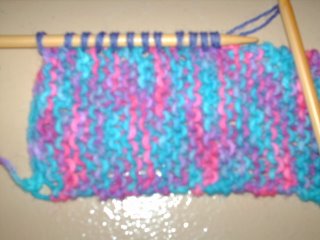 Second strip: Pick up, along a side edge, one stitch in each bar between the garter ridges, as many stitches as you like. It can be all the way across your first strip or only partially, as shown in the picture. Knit every row, end wsr (wrong side row), cast off. You can continue doing this as long as you want, there’s no recipe or preferred method.
[picking up stitches for the second strip or block]
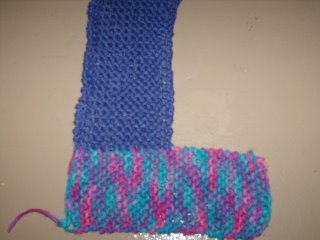
[completed second strip]
[picking up stitches across two perpendicular edges]
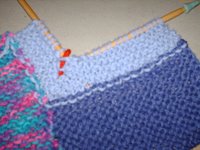
[knitting the mitered block, wrong side]
Repeat these two rows until you have two stitches left on one needle (you will have just finished a wrong side row). If the two remaining stitches are on the right needle, slip, knit, psso, drop marker and cast off across the row. If the two stitches are on the left needle, cast off to those last two stitches,
then cast them off as if they were one stitch.
This leaves you with an evenly edged rectangle. If you knit this row, then cast off on the wrong side row, it is not a mistake. The cast off row will rise above the rest of the square and be uneven, however, you can just knit over it as your afghan continues to grow, and there really won’t be a noticeable problem. I have left my marker loop to show the miter line.
Most of us knitters have bags, boxes or bins full of oddballs that we’d like to use, and not everyone is a mathematician, a genius or an expert. These directions are generalized for use by anyone, from beginner to master. You can tweak, revise, alter to your heart’s content and the maximum of your expertise. It’s encouraged, in fact, to add spice and learning to the process of making your own! There will be at least three parts, possibly more, since blogspot will only take so much in terms of pictures in one day or post.
General Notes: This is not a pattern. It is a guide for making and joining different types of squares and rectangles in garter stitch to wind up with a crazy quilt effect. Yours will be unique and individual, as large or small as you like it. Some parts may not satisfy nit-picking expert purists, but I really don’t care. Garter stitch is easy, stretchy and forgiving of many different types of mistakes, which makes it perfect for experimental or inexpert knitting!
Materials used: odds and ends of worsted weight yarn, or thinner yarn doubled to worsted weight (it is important that the yarns have fairly similar washing and drying instructions). You may also use sock yarn, whatever, with needle size adjusted accordingly.
One pair of needles, one to two sizes larger than recommended for that weight yarn, to increase drape and loosen up the tightness of garter stitch. At some point you may wish to have circular needles on hand, particularly around the time you make a border.
One or two markers or yarn loops for marking miters
First strip: cast on as many stitches as you like, knit every row. Last row worked should be a wrong side row (put a pin in the right side, if you wish, to remind you of which side is which). Cast off.
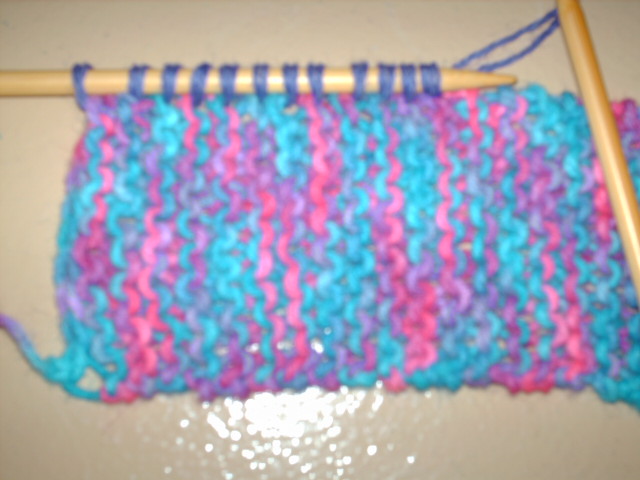 Second strip: Pick up, along a side edge, one stitch in each bar between the garter ridges, as many stitches as you like. It can be all the way across your first strip or only partially, as shown in the picture. Knit every row, end wsr (wrong side row), cast off. You can continue doing this as long as you want, there’s no recipe or preferred method.
[picking up stitches for the second strip or block]
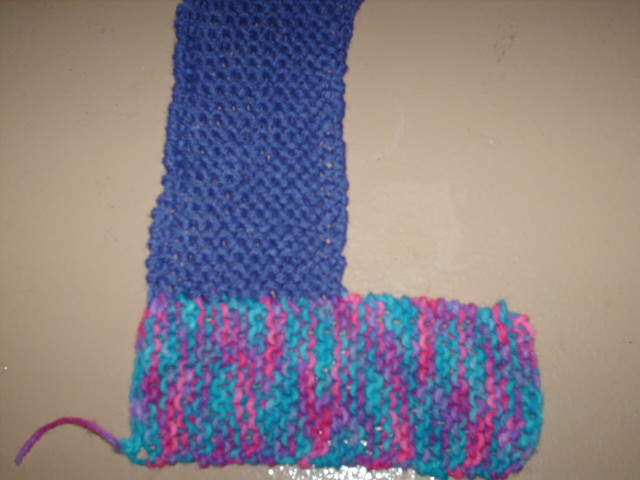
[completed second strip]
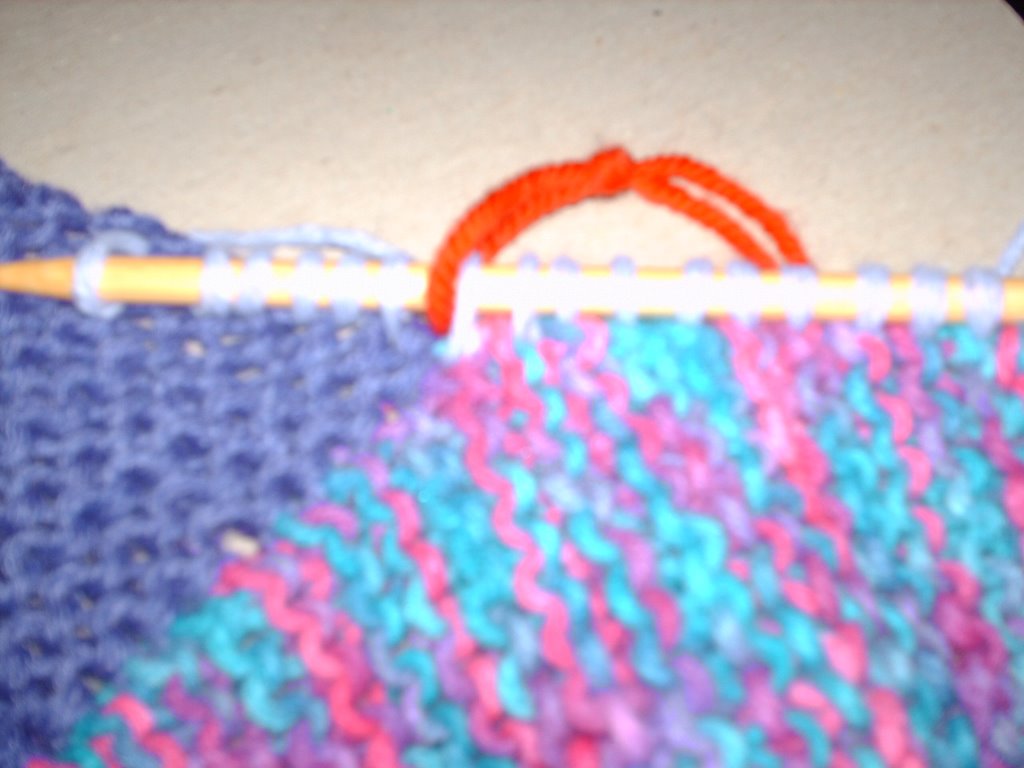
[picking up stitches across two perpendicular edges]
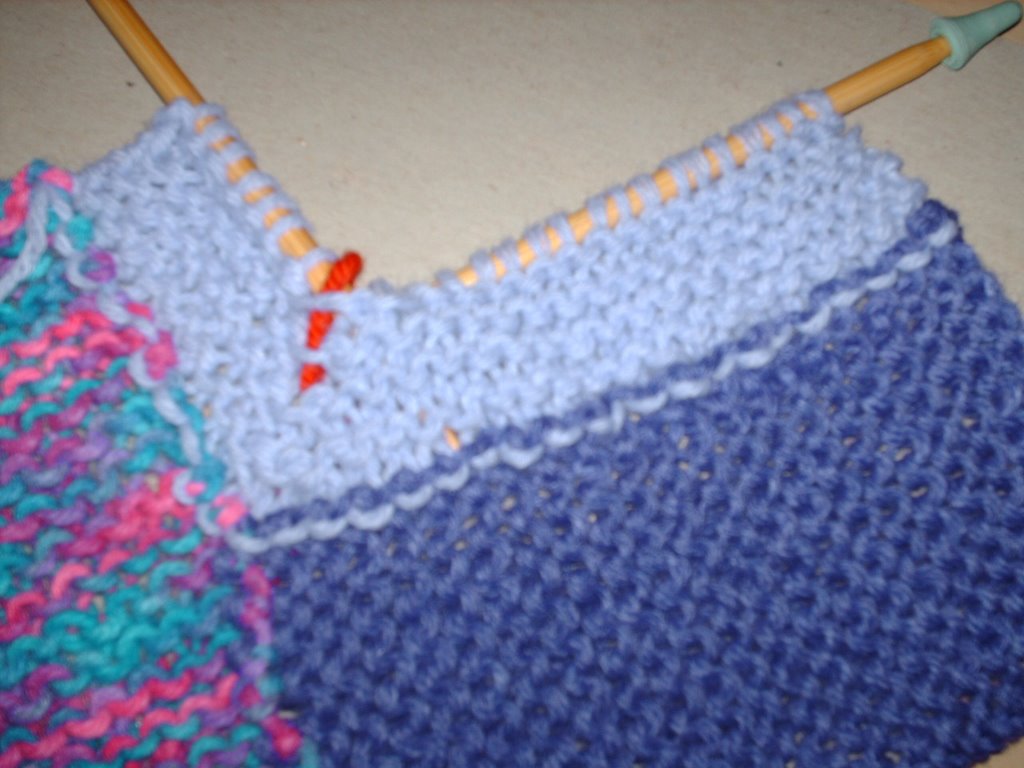
[knitting the mitered block, wrong side]
Repeat these two rows until you have two stitches left on one needle (you will have just finished a wrong side row). If the two remaining stitches are on the right needle, slip, knit, psso, drop marker and cast off across the row. If the two stitches are on the left needle, cast off to those last two stitches,
then cast them off as if they were one stitch.
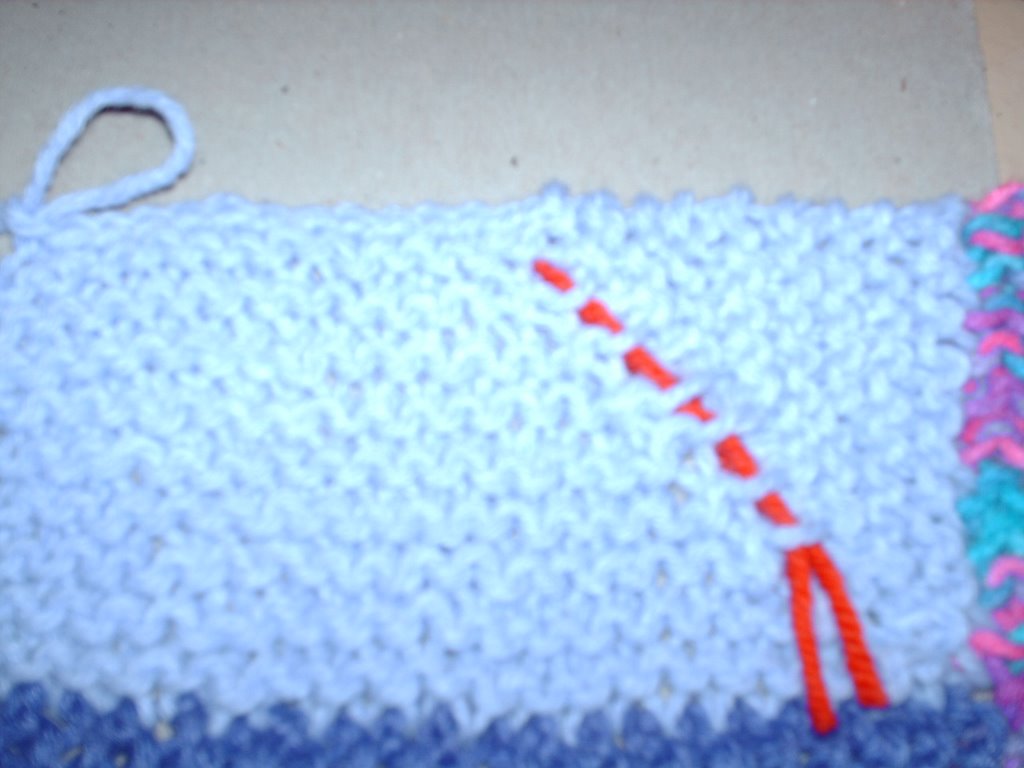
This leaves you with an evenly edged rectangle. If you knit this row, then cast off on the wrong side row, it is not a mistake. The cast off row will rise above the rest of the square and be uneven, however, you can just knit over it as your afghan continues to grow, and there really won’t be a noticeable problem. I have left my marker loop to show the miter line.
DEAD WORD OF THE DAY
thumbassing: fumbling with the hands as if the fingers were all thumbs
(from The Word Museum by Jeffrey Kacirk)
(from The Word Museum by Jeffrey Kacirk)
Wednesday, July 26, 2006
It’s Another Silly Season
Well, college registration is upon us. Spawn is going off to a 2-year college to collect some general education credits for cheap before heading off to a 4-year university. If he does so. Hmmm. Sometimes I worry about him. He can be so defiant of authority that he cuts off his nose to spite his face, and I’m feeling a distant zephyr of this particular ill wind right now.
He went to registration yesterday. As I watched the back of his head leave, I hollered out, “Make sure everything you register for is transferable!” I got a lax wave of the hand in reply. He returned, a couple of hours later, with his registration sheet, which includes all of 12 credit hours. My eyeballs started spinning. Then I read his class list and one eyeball started spinning faster than the other one. I can really put Marty Feldman to shame when I get in full Maternal Smother Overdrive!
Anyway, he signed up for one class called “Orientation to the College Experience”. What the hell is that? “Here’s the cafeteria; have your parents make their checks payable to the Bursar; don’t cheat on anything; here’s the library…”? WTF, dude.
When I went off to college, my parents cheerfully drove my boxes and me to a Very Large State University several hundred miles from home, scoped out my room; we dropped off my stuff and went to lunch. They spoke in encouraging terms and then dumped me at the dormitory door. I think they went out for drinks and possibly a lusty celebratory night at a motel afterwards. My “Orientation to the College Experience” consisted of trying to find all my classes by means of a map seemingly charted by directionally challenged illiterates and clutching my chest when I realized my summer earnings were not enough to purchase the de-luxe editions of all my required texts. GASP! At least the food was paid for in advance.
My roomie hated me before she met me because, unbeknownst to me, she had tried to get a friend from home as her roomie, and I had somehow usurped friend’s spot. Consequently, I wound up with anywhere from two to six roomies several nights of the week because my roomie’s friends kept coming over to keep her company and commiserate. Chopped liver, that’s me.
After several weeks of unintentionally stepping on people’s stomachs on my way to the toilet in the middle of the night, I complained to the Resident Advisor (an upperclass – er – person who was in charge of keeping it down to a dull roar on the floor) about too many overnight visitors, and my roomie took her revenge by using my cosmetics to paint an effigy of me on my pillowcase and hanging it from a noose from the 18th floor -- out our window. She then smashed all my breakables, which were mostly those same cosmetics, and had her bodacious friends come back over even more often and poke me awake during the nights.
Not surprisingly, I was less often than perky for my 8 a.m. General Chemistry class, where I was a yawning star amongst 350 other cross-eyed and dazed freshmen. That was followed by my first German class, where the scrutiny was intense, as the class had only 8 students, and then I had chemistry lab with the doofus partner from hell. After a short lunch break, which really got used by my dashing 80 miles across campus with 4,000 pounds of textbooks on my back, I had Calculus with possibly the mumbliest professor on campus. I think the excessive amount of facial hair he sported may have had something to do with the mumbling. I rounded off my day with freshman English and a computer science course back in the dark ages of punch cards.
Adding to my state of perpetual alarm was the fact that my counselor seemed to be on a quest to make me into the most overburdened student in history. First, she tried to convince me to come out of the starting box with a double major in Chemistry and Business. I demurred. She argued with me over taking German, since I already had sufficient language classes in French from high school, but I overcame her objections by trying to sell it as my “blow off” class. Hahahahahaha! Boy, was it ever NOT! It was, though, incredibly fun, and difficult in a different way from the analytical overload of the rest of my schedule. My counselor tried to add another class to my schedule, which would have put it in the 20-hour range and required dean’s approval, and I had to leave the room to hyperventilate in the ladies’ room. We finally compromised, and I wound up with a mere bleeding-from-the-eyes load of 18 hours. Now, THERE’s some “college orientation” for ya!
I was fortunate enough to be put on independent study for the English class, which saved me some time humping from one building to another during the day. It meant, however, that I had to write four upperclassman quality theses of 25 pages each, which were reviewed in written form, then I was orally quizzed by the entire graduate assistant component of the English department. I’d have been more intimidated by that if I’d known in advance, but I showed up for my first review, which I thought was going to be pretty casual, with just me and my instructor, to find a clump of 7 surly, long-haired grad students in English staring at me from their perches in the inner courtyard of the Humanities Plex. I don’t think I blinked during the entire 2-hour interrogation. I may have peed myself, but I honestly don’t remember to this very day. I spent the next 12 hours completely numb from my ankles to my fingertips, babbling about hubris.
Which didn’t make me any more popular with my roomie, who was flunking remedial BB stacking. About halfway through the first semester, I got to move to another room with a gal who, while she did not have a passel of friends over spending the night, did have the interesting quirk of being an amateur hairdresser. She earned her pocket money by cutting hair. In my chair, at my desk. And she didn’t clean it up. So, I got to come back to the room, sweep 8 different kinds of alien hair off my desk and the floor and relax by studying until someone yelled at me to turn off the &#^$%@ light and go to (&#$%^*(*^^ bed.
I passed everything somehow, and, being completely insane, signed up for 19 hours the following semester. My counselor tried to push me into triple majoring in Chemistry, Business and German. I think I started drooling, which was a marginal improvement over hyperventilating. Man, was I “oriented”.
So, when I look at Spawn’s 12-hour schedule, including “Orientation to the College Experience”, I have flashbacks and some low-grade envy. I probably would have benefited from an orientation class, depending on what’s covered. I know he has a tendency to take the Slacker Path, which is not something I can change, and the hours will, oddly enough, transfer to four-year state universities. Whodathunkit?
I spoke up, briefly, and tried to avoid smothering him about the hour count and how we were really only going to pay for 8 semesters, that how he filled them was up to him. He’ll have some bleeding-from-the-eyeballs semesters in his future, too. I hope he winds up with as many goofy stories and having had as much fun as I did. Because I really wouldn’t want for him to miss the REAL “College Experience” after all.
He went to registration yesterday. As I watched the back of his head leave, I hollered out, “Make sure everything you register for is transferable!” I got a lax wave of the hand in reply. He returned, a couple of hours later, with his registration sheet, which includes all of 12 credit hours. My eyeballs started spinning. Then I read his class list and one eyeball started spinning faster than the other one. I can really put Marty Feldman to shame when I get in full Maternal Smother Overdrive!
Anyway, he signed up for one class called “Orientation to the College Experience”. What the hell is that? “Here’s the cafeteria; have your parents make their checks payable to the Bursar; don’t cheat on anything; here’s the library…”? WTF, dude.
When I went off to college, my parents cheerfully drove my boxes and me to a Very Large State University several hundred miles from home, scoped out my room; we dropped off my stuff and went to lunch. They spoke in encouraging terms and then dumped me at the dormitory door. I think they went out for drinks and possibly a lusty celebratory night at a motel afterwards. My “Orientation to the College Experience” consisted of trying to find all my classes by means of a map seemingly charted by directionally challenged illiterates and clutching my chest when I realized my summer earnings were not enough to purchase the de-luxe editions of all my required texts. GASP! At least the food was paid for in advance.
My roomie hated me before she met me because, unbeknownst to me, she had tried to get a friend from home as her roomie, and I had somehow usurped friend’s spot. Consequently, I wound up with anywhere from two to six roomies several nights of the week because my roomie’s friends kept coming over to keep her company and commiserate. Chopped liver, that’s me.
After several weeks of unintentionally stepping on people’s stomachs on my way to the toilet in the middle of the night, I complained to the Resident Advisor (an upperclass – er – person who was in charge of keeping it down to a dull roar on the floor) about too many overnight visitors, and my roomie took her revenge by using my cosmetics to paint an effigy of me on my pillowcase and hanging it from a noose from the 18th floor -- out our window. She then smashed all my breakables, which were mostly those same cosmetics, and had her bodacious friends come back over even more often and poke me awake during the nights.
Not surprisingly, I was less often than perky for my 8 a.m. General Chemistry class, where I was a yawning star amongst 350 other cross-eyed and dazed freshmen. That was followed by my first German class, where the scrutiny was intense, as the class had only 8 students, and then I had chemistry lab with the doofus partner from hell. After a short lunch break, which really got used by my dashing 80 miles across campus with 4,000 pounds of textbooks on my back, I had Calculus with possibly the mumbliest professor on campus. I think the excessive amount of facial hair he sported may have had something to do with the mumbling. I rounded off my day with freshman English and a computer science course back in the dark ages of punch cards.
Adding to my state of perpetual alarm was the fact that my counselor seemed to be on a quest to make me into the most overburdened student in history. First, she tried to convince me to come out of the starting box with a double major in Chemistry and Business. I demurred. She argued with me over taking German, since I already had sufficient language classes in French from high school, but I overcame her objections by trying to sell it as my “blow off” class. Hahahahahaha! Boy, was it ever NOT! It was, though, incredibly fun, and difficult in a different way from the analytical overload of the rest of my schedule. My counselor tried to add another class to my schedule, which would have put it in the 20-hour range and required dean’s approval, and I had to leave the room to hyperventilate in the ladies’ room. We finally compromised, and I wound up with a mere bleeding-from-the-eyes load of 18 hours. Now, THERE’s some “college orientation” for ya!
I was fortunate enough to be put on independent study for the English class, which saved me some time humping from one building to another during the day. It meant, however, that I had to write four upperclassman quality theses of 25 pages each, which were reviewed in written form, then I was orally quizzed by the entire graduate assistant component of the English department. I’d have been more intimidated by that if I’d known in advance, but I showed up for my first review, which I thought was going to be pretty casual, with just me and my instructor, to find a clump of 7 surly, long-haired grad students in English staring at me from their perches in the inner courtyard of the Humanities Plex. I don’t think I blinked during the entire 2-hour interrogation. I may have peed myself, but I honestly don’t remember to this very day. I spent the next 12 hours completely numb from my ankles to my fingertips, babbling about hubris.
Which didn’t make me any more popular with my roomie, who was flunking remedial BB stacking. About halfway through the first semester, I got to move to another room with a gal who, while she did not have a passel of friends over spending the night, did have the interesting quirk of being an amateur hairdresser. She earned her pocket money by cutting hair. In my chair, at my desk. And she didn’t clean it up. So, I got to come back to the room, sweep 8 different kinds of alien hair off my desk and the floor and relax by studying until someone yelled at me to turn off the &#^$%@ light and go to (&#$%^*(*^^ bed.
I passed everything somehow, and, being completely insane, signed up for 19 hours the following semester. My counselor tried to push me into triple majoring in Chemistry, Business and German. I think I started drooling, which was a marginal improvement over hyperventilating. Man, was I “oriented”.
So, when I look at Spawn’s 12-hour schedule, including “Orientation to the College Experience”, I have flashbacks and some low-grade envy. I probably would have benefited from an orientation class, depending on what’s covered. I know he has a tendency to take the Slacker Path, which is not something I can change, and the hours will, oddly enough, transfer to four-year state universities. Whodathunkit?
I spoke up, briefly, and tried to avoid smothering him about the hour count and how we were really only going to pay for 8 semesters, that how he filled them was up to him. He’ll have some bleeding-from-the-eyeballs semesters in his future, too. I hope he winds up with as many goofy stories and having had as much fun as I did. Because I really wouldn’t want for him to miss the REAL “College Experience” after all.
DEAD WORD OF THE DAY
lewstery: to bustle and stir about, like a lusty wench
(from The Word Museum by Jeffrey Kacirk)
(from The Word Museum by Jeffrey Kacirk)
Tuesday, July 25, 2006
Respecting Kids’ “No’s”
(I’m not sure that apostrophe is grammatically correct, but what the heck!)
Over our morning coffee today, my husband and I were talking about how different people react to hearing the word “no.” Some people will take it as final and go on with their lives. Others are pushers; they hear the word “no” and it means “try harder, I’m not convinced yet that you mean it.” Then they try a variety of tactics, selling the benefits of saying “yes”, telling you what a great boon it would be to them if you would only agree, telling you what a great boon it would be to YOU if you would only say “yes”. Others go even further into nastiness and start implying that you are selfish for saying “no” or that you are deliberately disappointing them by saying “no” or that you are somehow attempting to control THEM by refusing whatever their request was. The last one is just astounding to me, it’s so manipulative. Lots of people do it, though. Or, they’ll look amazed that you’ve refused them, try to find a time when you can do what they ask, as if it’s merely inconvenient, etc. I have met more “pushers” than “accepters” in my life.
My Mom was a notorious pusher. “No” was never the right answer. In fact, “no” was a slap in her face. If she requested something, she wasn’t really requesting, she was commanding. A request that does not allow a refusal is a command, so all her “would you” and “could you” and “do you mind” statements were not questions, they were orders. If I continued to refuse, she would quickly move to the denigrating phase – “how can you be so lazy/selfish/mean, etc. as to refuse my ‘request’,” she’d say. Then she’d move to how much damage I was doing to her by refusing, “Don’t you want me to be happy? Don’t you want to help me out? Don’t you think you owe it to me? Why are you doing this to me? I can’t believe you’re so intent on ruining my life! You’re so disobedient!” Blah, effing blah, on and on the rant would go. Eventually, the only choice was capitulation, otherwise, I would hear about how evil I was for a very, very long time, and she’d pull others in on it, too.
“Can you believe,” she’d start out, “that my daughter refused, outright REFUSED to…” she’d say to a church friend with a tone of high outrage. There would be tongue clucking, shaking of heads, and then some well-intentioned third party would have go at me. What horseshit! Utter and complete horseshit.
The punishment for saying “no” to a “request” would go on – I’d get the cold shoulder for literally days. She’d stop doing my laundry or setting me a place at the table, or I’d have to eat cold leftover crap at a TV tray while the rest of the family dined on hot food at the dinner table. Sometimes there was physical punishment, too. I was banned, shunned, treated like dung on her shoe until I gave in. Sometimes, if I stuck to my guns, things would seem to smooth over after a couple of weeks and then months later, I’d hear about it again, usually as a topic of conversation or as a subtle form of “you owe me” blackmail. “The last time I asked you to…” Mom would say, “you REFUSED! And I had to do it all MYSELF! Now, this time, will you….” And, I usually did, not wanting to go through the nastiness that was involved in saying “no”.
Through the years, having my “no”, my boundary, ignored has led to some difficult times. I have done things I really would rather not have done because to me, subconsciously, any request was a command and there was no option other than acquiescence. I would say “no” and then the pushing would begin. I’d feel the whole crushing load of how my refusals were treated as a child coming over me again and just give in instead of standing my ground. Sometimes I would exit the situation or run away in some other way in order to protect my boundaries. It was difficult learning to stand and defend my right to refuse things.
I was helped by the anti-rape campaign that started gaining ground in the 70’s. The catchphrase was “No means NO!” After years and years of women being blamed in the courts, in society, within their families, and even amongst their friends, for having been raped, this particular offshoot of women’s lib was, truly, liberating. No meant no. It meant no whether you were dressed like a nun or a Playboy bunny. No meant no whether the person pushing was your spouse or your boss or some icky stranger. It just meant no. Always. I watched with exhilaration as the rest of society learned what I had been trying so hard for so long to defend – my absolute right to refuse something. And I was happy to extrapolate – it didn’t matter if I was saying “no” to sex, a trip to an amusement park, a book recommendation, or butter on my toast.
Because “no” means no. Always. And, as far as I’m concerned, that should be the end of the discussion or pressure to agree. A request, an answer, it’s over. Move on. Don’t take the refusal personally, but accept it as the other person’s choice. Next!
I have tried, as a parent, to follow my conscience, my respect for other people’s “no’s”. I have caught myself pushing, even though I know better, particularly with my kids, and I am ashamed of myself when I catch myself not showing respect for their wishes.
When they were in their terrible twos, “no” was something cool to say. It meant Mom looked surprised and went and did something else. It also meant that whatever Mom had offered was dispensed elsewhere. That’s the consequence of saying “no” for a two year old. It was easier then. I learned to either ask a direct yes or no question and cope accordingly with the response, to phrase the question as a choice, as in “do you want French toast or cereal for breakfast” rather than enter the quicksand zone by asking “do you want breakfast” to which a negative response is really not what I was looking for with a kid who is clearly hungry. Or I learned to go ahead and issue a command, “I need you to help me pick up the toys in this room. You start over there.” I was trying my darnedest not to repeat my own mother’s mistakes.
As they got older, it got harder. I would offer the option of swimming lessons, only to be refused, and then I’d start selling. “Oh, gosh, I really think you’d enjoy them; you love playing in our pool.” Or, “Are you sure? I think it would be good exercise and a chance to meet some new kids.” Ouch. My bad. My very bad. Because there is a difference between encouraging children and pushing them beyond their boundaries. I learned to ask exploratory questions with as little unconscious manipulation as possible, preparatory narrative explanations and clearly stated reasons. “The school is offering music lessons. If you would like to learn to play an instrument, please let me know. The parents’ meeting is on the 9th, and I’d like for you to think about it and let me know by the 6th if you think you would like to give it a try. Do you have any feelings about it now or do you want to think about it until then?” Or something much like that.
My two sons have no problem with understanding that I feel neutral about things I phrase in that manner. They understand that I’m just presenting information for their consideration and that my life and my feelings for them are not going to change depending on their answers. My daughter tends to interpret things as, “if Mom mentioned it, she must want me to do it.” It took me a while to twig to that, and I’m working hard to make it easier for her to say “no” to me without worrying about repercussions of some sort. I never know if I’m explaining too much, offering too many options, exploring too many consequences out loud, or what. I just don’t know unless she says something like, “OK, Mom, I GET it.”
I have to watch myself very carefully to make sure that I don’t fall into the patterns that I was raised with – I have caught myself phrasing commands as requests and then having to backpedal and rephrase. I apologize for misstating my intent, and the kids give me the fisheye, but they understand.
I don’t know if my kids realize why I’m so exacting about respecting their “no’s”. I hope to help them understand that they have the right to draw a line in the sand, regardless of how powerful the authority figure facing them is. A Mom is a pretty powerful authority figure, and if I can respect their boundaries, then the rest of the world better damn well do so as well. I hope they will grow to defend their boundaries without giving it a second thought, without second-guessing themselves, and without feeling the crushing pressure to give in that I felt when I was first learning to do so. I hope that when someone pressures them to do something they don’t want to do, something they know is wrong, they feel a sense of anger that someone would push like that, and stand even more firmly in their decisions. I hope that if someone is just stating things badly, they will feel free to ask questions, clarify goals, and come to a compromise or a decision that does not make them feel coerced, conned, or emotionally blackmailed.
I don’t know if I’m doing it right, I just know I’m doing the best I can. The long-term consequences of ignoring children’s boundaries are huge and life altering, and I don’t want to do that to them. I want for them to own their own power, their own space, and their own boundaries.
Wish me luck.
Over our morning coffee today, my husband and I were talking about how different people react to hearing the word “no.” Some people will take it as final and go on with their lives. Others are pushers; they hear the word “no” and it means “try harder, I’m not convinced yet that you mean it.” Then they try a variety of tactics, selling the benefits of saying “yes”, telling you what a great boon it would be to them if you would only agree, telling you what a great boon it would be to YOU if you would only say “yes”. Others go even further into nastiness and start implying that you are selfish for saying “no” or that you are deliberately disappointing them by saying “no” or that you are somehow attempting to control THEM by refusing whatever their request was. The last one is just astounding to me, it’s so manipulative. Lots of people do it, though. Or, they’ll look amazed that you’ve refused them, try to find a time when you can do what they ask, as if it’s merely inconvenient, etc. I have met more “pushers” than “accepters” in my life.
My Mom was a notorious pusher. “No” was never the right answer. In fact, “no” was a slap in her face. If she requested something, she wasn’t really requesting, she was commanding. A request that does not allow a refusal is a command, so all her “would you” and “could you” and “do you mind” statements were not questions, they were orders. If I continued to refuse, she would quickly move to the denigrating phase – “how can you be so lazy/selfish/mean, etc. as to refuse my ‘request’,” she’d say. Then she’d move to how much damage I was doing to her by refusing, “Don’t you want me to be happy? Don’t you want to help me out? Don’t you think you owe it to me? Why are you doing this to me? I can’t believe you’re so intent on ruining my life! You’re so disobedient!” Blah, effing blah, on and on the rant would go. Eventually, the only choice was capitulation, otherwise, I would hear about how evil I was for a very, very long time, and she’d pull others in on it, too.
“Can you believe,” she’d start out, “that my daughter refused, outright REFUSED to…” she’d say to a church friend with a tone of high outrage. There would be tongue clucking, shaking of heads, and then some well-intentioned third party would have go at me. What horseshit! Utter and complete horseshit.
The punishment for saying “no” to a “request” would go on – I’d get the cold shoulder for literally days. She’d stop doing my laundry or setting me a place at the table, or I’d have to eat cold leftover crap at a TV tray while the rest of the family dined on hot food at the dinner table. Sometimes there was physical punishment, too. I was banned, shunned, treated like dung on her shoe until I gave in. Sometimes, if I stuck to my guns, things would seem to smooth over after a couple of weeks and then months later, I’d hear about it again, usually as a topic of conversation or as a subtle form of “you owe me” blackmail. “The last time I asked you to…” Mom would say, “you REFUSED! And I had to do it all MYSELF! Now, this time, will you….” And, I usually did, not wanting to go through the nastiness that was involved in saying “no”.
Through the years, having my “no”, my boundary, ignored has led to some difficult times. I have done things I really would rather not have done because to me, subconsciously, any request was a command and there was no option other than acquiescence. I would say “no” and then the pushing would begin. I’d feel the whole crushing load of how my refusals were treated as a child coming over me again and just give in instead of standing my ground. Sometimes I would exit the situation or run away in some other way in order to protect my boundaries. It was difficult learning to stand and defend my right to refuse things.
I was helped by the anti-rape campaign that started gaining ground in the 70’s. The catchphrase was “No means NO!” After years and years of women being blamed in the courts, in society, within their families, and even amongst their friends, for having been raped, this particular offshoot of women’s lib was, truly, liberating. No meant no. It meant no whether you were dressed like a nun or a Playboy bunny. No meant no whether the person pushing was your spouse or your boss or some icky stranger. It just meant no. Always. I watched with exhilaration as the rest of society learned what I had been trying so hard for so long to defend – my absolute right to refuse something. And I was happy to extrapolate – it didn’t matter if I was saying “no” to sex, a trip to an amusement park, a book recommendation, or butter on my toast.
Because “no” means no. Always. And, as far as I’m concerned, that should be the end of the discussion or pressure to agree. A request, an answer, it’s over. Move on. Don’t take the refusal personally, but accept it as the other person’s choice. Next!
I have tried, as a parent, to follow my conscience, my respect for other people’s “no’s”. I have caught myself pushing, even though I know better, particularly with my kids, and I am ashamed of myself when I catch myself not showing respect for their wishes.
When they were in their terrible twos, “no” was something cool to say. It meant Mom looked surprised and went and did something else. It also meant that whatever Mom had offered was dispensed elsewhere. That’s the consequence of saying “no” for a two year old. It was easier then. I learned to either ask a direct yes or no question and cope accordingly with the response, to phrase the question as a choice, as in “do you want French toast or cereal for breakfast” rather than enter the quicksand zone by asking “do you want breakfast” to which a negative response is really not what I was looking for with a kid who is clearly hungry. Or I learned to go ahead and issue a command, “I need you to help me pick up the toys in this room. You start over there.” I was trying my darnedest not to repeat my own mother’s mistakes.
As they got older, it got harder. I would offer the option of swimming lessons, only to be refused, and then I’d start selling. “Oh, gosh, I really think you’d enjoy them; you love playing in our pool.” Or, “Are you sure? I think it would be good exercise and a chance to meet some new kids.” Ouch. My bad. My very bad. Because there is a difference between encouraging children and pushing them beyond their boundaries. I learned to ask exploratory questions with as little unconscious manipulation as possible, preparatory narrative explanations and clearly stated reasons. “The school is offering music lessons. If you would like to learn to play an instrument, please let me know. The parents’ meeting is on the 9th, and I’d like for you to think about it and let me know by the 6th if you think you would like to give it a try. Do you have any feelings about it now or do you want to think about it until then?” Or something much like that.
My two sons have no problem with understanding that I feel neutral about things I phrase in that manner. They understand that I’m just presenting information for their consideration and that my life and my feelings for them are not going to change depending on their answers. My daughter tends to interpret things as, “if Mom mentioned it, she must want me to do it.” It took me a while to twig to that, and I’m working hard to make it easier for her to say “no” to me without worrying about repercussions of some sort. I never know if I’m explaining too much, offering too many options, exploring too many consequences out loud, or what. I just don’t know unless she says something like, “OK, Mom, I GET it.”
I have to watch myself very carefully to make sure that I don’t fall into the patterns that I was raised with – I have caught myself phrasing commands as requests and then having to backpedal and rephrase. I apologize for misstating my intent, and the kids give me the fisheye, but they understand.
I don’t know if my kids realize why I’m so exacting about respecting their “no’s”. I hope to help them understand that they have the right to draw a line in the sand, regardless of how powerful the authority figure facing them is. A Mom is a pretty powerful authority figure, and if I can respect their boundaries, then the rest of the world better damn well do so as well. I hope they will grow to defend their boundaries without giving it a second thought, without second-guessing themselves, and without feeling the crushing pressure to give in that I felt when I was first learning to do so. I hope that when someone pressures them to do something they don’t want to do, something they know is wrong, they feel a sense of anger that someone would push like that, and stand even more firmly in their decisions. I hope that if someone is just stating things badly, they will feel free to ask questions, clarify goals, and come to a compromise or a decision that does not make them feel coerced, conned, or emotionally blackmailed.
I don’t know if I’m doing it right, I just know I’m doing the best I can. The long-term consequences of ignoring children’s boundaries are huge and life altering, and I don’t want to do that to them. I want for them to own their own power, their own space, and their own boundaries.
Wish me luck.
DEAD WORD OF THE DAY
daw: daw, in common speech, is to awaken; to be dawed, to have shaken off sleep, to be fully awakened and to come to one's self out of a deep sleep.
(from The Word Museum by Jeffrey Kacirk)
(from The Word Museum by Jeffrey Kacirk)
Friday, July 21, 2006
Five Things I Wish I’d Known as a Teenaged Girl
1. Guys like girls who are touchable and accessible, and I don’t mean sleazy. I mean girls whose hair isn’t all crackly with hairspray and perms, who are not an inch deep in slippery make-up, and who are not so skinny that it hurts to hug them. They are also more inclined to prefer fun-loving, easy-going, well-adjusted, reasonably confident girls who like themselves, not freaked out super self-conscious fashion plates. Well, normal guys, anyway.
2. Fame and stardom are not all they seem. I don’t think I ever noticed how nasty and mean-spirited tabloids and magazines could be when I was a teenager. Maybe they weren’t that mean. They sure are now! Anyone who is voluntarily in the public eye, particularly models, actresses, singers, and the like, is going to be roasted, toasted, insulted, lied about, spied on, defamed, and slandered in the worst possible ways by the media seeking to make a buck along with a sensation. Then there are lunatic stalkers, crazed fans, a need for bodyguards, security systems, and a complete lack of privacy for all the activities that we, the great unwashed and unknown, take for granted. And pressure – pressure to be the best at what you do, wear the spiffiest clothes, be more forthcoming, be more mysterious, always more, more, more. Even the ones who look like they’ve got it all are under pressure to do or be more in one way or another. A lot of them break under the pressure. Kudos to those who don’t and who can remain themselves.
3. Exercise is better than dieting. I was the queen of the starvation diets as a teen. I wish I had just ridden an exercycle more and done sit-ups and taken walks instead. Too much time spent focusing on food and the avoidance thereof distracted me from developing a lasting exercise habit. I work everyday now to motivate myself to exercise, and sometimes the mental workout is more exhausting than the physical one. I wish I had, as a teen, turned myself into one of those people who don’t feel right until they’ve walked a mile or ridden a bike, or done something fairly vigorous for a portion of the day. I envy them, and, maybe, if I keep at it, by the time I’m 102, I’ll be eager to get my wrinkled self over to the mall and stride creakily about for a half an hour. A gal can dream!
4. High school is NOT the best time of your life, most likely. People kept saying that to me, and I thought they were stupid. I didn’t want to believe them because I thought high school was boring and consisted largely of avoiding being either emotionally or physically abused by cranks, wankers and generally angry, maladjusted people. If I had not had at least a modicum of doubt about high school being “the best time of my life” I’d have shot myself in the forehead based on the idea that it was only going to get worse. Aspects of high school were fun – friends, some activities, occasional classes, being young – those things were fun. Things have gotten better, and I really couldn’t classify a “best time of my life”. I wake up every morning thinking it could be just around the corner, or maybe it was yesterday, or it might be just lying there, staring at the ceiling in a comfortable home I share with people and pets that I love and enjoy. College was fun…and scary. Being in my 20’s was fun…and scary. Getting married was fun…and scary. And so on.
5. Good friends are more important than boyfriends. Good friends don’t mind spending time with you on your worst day. You could be sick, covered in zits, in desperate need of a shower and some penicillin, and your good friends still like you just as much as they do when you’re really on your game. Boyfriends have something else altogether on their minds. You never have to worry if you’re good enough, pretty enough, smart enough, or enough of anything for your friends. You are you, and that’s enough. I wish that I, and my friends, had spent more time enjoying each other rather than worrying about boyfriends.
2. Fame and stardom are not all they seem. I don’t think I ever noticed how nasty and mean-spirited tabloids and magazines could be when I was a teenager. Maybe they weren’t that mean. They sure are now! Anyone who is voluntarily in the public eye, particularly models, actresses, singers, and the like, is going to be roasted, toasted, insulted, lied about, spied on, defamed, and slandered in the worst possible ways by the media seeking to make a buck along with a sensation. Then there are lunatic stalkers, crazed fans, a need for bodyguards, security systems, and a complete lack of privacy for all the activities that we, the great unwashed and unknown, take for granted. And pressure – pressure to be the best at what you do, wear the spiffiest clothes, be more forthcoming, be more mysterious, always more, more, more. Even the ones who look like they’ve got it all are under pressure to do or be more in one way or another. A lot of them break under the pressure. Kudos to those who don’t and who can remain themselves.
3. Exercise is better than dieting. I was the queen of the starvation diets as a teen. I wish I had just ridden an exercycle more and done sit-ups and taken walks instead. Too much time spent focusing on food and the avoidance thereof distracted me from developing a lasting exercise habit. I work everyday now to motivate myself to exercise, and sometimes the mental workout is more exhausting than the physical one. I wish I had, as a teen, turned myself into one of those people who don’t feel right until they’ve walked a mile or ridden a bike, or done something fairly vigorous for a portion of the day. I envy them, and, maybe, if I keep at it, by the time I’m 102, I’ll be eager to get my wrinkled self over to the mall and stride creakily about for a half an hour. A gal can dream!
4. High school is NOT the best time of your life, most likely. People kept saying that to me, and I thought they were stupid. I didn’t want to believe them because I thought high school was boring and consisted largely of avoiding being either emotionally or physically abused by cranks, wankers and generally angry, maladjusted people. If I had not had at least a modicum of doubt about high school being “the best time of my life” I’d have shot myself in the forehead based on the idea that it was only going to get worse. Aspects of high school were fun – friends, some activities, occasional classes, being young – those things were fun. Things have gotten better, and I really couldn’t classify a “best time of my life”. I wake up every morning thinking it could be just around the corner, or maybe it was yesterday, or it might be just lying there, staring at the ceiling in a comfortable home I share with people and pets that I love and enjoy. College was fun…and scary. Being in my 20’s was fun…and scary. Getting married was fun…and scary. And so on.
5. Good friends are more important than boyfriends. Good friends don’t mind spending time with you on your worst day. You could be sick, covered in zits, in desperate need of a shower and some penicillin, and your good friends still like you just as much as they do when you’re really on your game. Boyfriends have something else altogether on their minds. You never have to worry if you’re good enough, pretty enough, smart enough, or enough of anything for your friends. You are you, and that’s enough. I wish that I, and my friends, had spent more time enjoying each other rather than worrying about boyfriends.
DEAD WORD OF THE DAY
babies-in-the-eyes: the miniature reflection of himself which a person sees in the pupil of another's eye on looking closely into it. Our old poets make it an employment of lovers to look for them in each other's eyes. Sportively called by our ancestors a "little boy" or "baby", and made the subject of many amorous allusions.
(from The Word Museum by Jeffrey Kacirk)
(from The Word Museum by Jeffrey Kacirk)
German Idiom for Friday
Lehrgeld zahlen: to learn things the hard way (literally, to pay tuition; to pay to learn)
zB:Leute, die nicht auf vernuenftigen Rat hoeren wollen, muessen oft viel Lehrgeld zahlen.
auf Englisch: People who don't like to listen to sound advice often have to learn things the hard way.
(from the Guide to German Idioms by J.P. Lupson)
zB:Leute, die nicht auf vernuenftigen Rat hoeren wollen, muessen oft viel Lehrgeld zahlen.
auf Englisch: People who don't like to listen to sound advice often have to learn things the hard way.
(from the Guide to German Idioms by J.P. Lupson)
Thursday, July 20, 2006
Knitting Reference Materials
I lost my trust in patterns years ago. I was crocheting a rug for my newlywed kitchen and followed the instructions absolutely. Everything was perfect, my gauge was dead on, I used the suggested materials, and I was looking forward to a nice oval rug that would look a little like the concentric oval rag rugs I remembered from my childhood. What I got was a ruffled, uneven nightmare. I cried. I doubted myself. I re-read the instructions. Since this was in the days before the Internet, I called the magazine for errata, and they told me they hadn’t heard of anyone else having a problem, so I sank into dejection and despair. Oh, woe! Then I got pissed, looked at the finished project and saw where the error began. I frogged back to it, reworked it, it came out perfect, so I gave it away. I couldn’t stand to look at it again, it just made me angry.
I had a similar experience with knitting a Sweater From Hell. I think every knitter eventually has one of these cross her path. The raglan edges don’t match up and there are little shoulder horns sticking up, or the damned thing has gorilla sleeves, the button band puckers, it bulges in odd and unflattering ways, it pinches in the underarms, the neck is strange and binds in weird places, and no amount of hopeful, optimistic blocking will cure it.
Do the pattern writers come to my house and fix their mistakes? They do not, the fiends. Neither do the magazine or book publishers. They just all sit out there in the vast open world, never held accountable for their heinous crimes and fraud. I think they get up in the early morning and giggle at us, enjoying our misery, remote and safe in their evil lairs, which are papered with our wasted dollar bills – schadenfreud of the yarn mavens. It’s enough to make a gal howl at the moon. (Which doesn’t help either, I’ve tried. It does bring attention and commiseration from the neighbors, though, which is not all bad.)
So, I went through a phase of just winging it. The problem was, there was no easily accessible reference material to tell me what sizes were considered standard for anything. I could swatch for gauge like nobody’s business; if there were an Olympic swatching division, I’d be captain. I have even made afghans and sweaters from my swatch piles. They’re weird but warm. I tried going into stores with a tape measure, a pencil and a little notebook to try to assemble my own reference chart of sizes. I got a lot of strange looks from clerks, which scared me off, wuss that I am.
The Internet has changed that. Now we have 8 whomptillion references for everything, which is just as bad because now I still don’t know whom to believe. Preemie heads can be any size from 8 inches to 12, and God only knows how big blankets should be. However, I’ve compiled a list of reference materials and locations that DO appear to have fairly consistent sizes, from things I’ve made that DO fit or suit, and which cross-reference with one another to achieve some general standards of uniformity. All of which is no help to anyone who feels that only individually customized items are worth producing. However, if you have any interest in just having a general reference, I hope the following will be of use to you – they’ve been extremely useful to me.
Hats: This freebie PDF offers a wide range of options. It has gauge-based instructions for yarn weights from fingering through bulky, and 6 head sizes, preemie through men. I re-wrote mine in MSExcel since this one prints out a little light and tiny.
http://www.purplekittyyarns.com/free-patterns/Gotcha-Covered-1-LW1268.pdf
Socks, Mittens, Hats, Tams, Gloves, Scarves, Vests, and Sweaters: Spend the $24.95 plus shipping, if only so you can throw out all your hinky and much-in-need-of-adjusting free patterns. I don’t recommend it for sweaters or vests, since the only sweater style is for set-in sleeves, which I don’t really care for, and I think the vests look funky, but it’s bang on for the others. The measurements, however, are reasonably accurate. Chock full o’charts, you may need a highlighter or pencil to keep track of what you’re supposed to be doing, but I really think this book is a worthy investment. It really reduces the frustration factor in finding baseline measurements for all those little accessories that are so much fun to make.
Knitter’s Handy Book of Patterns
More Sweaters: Ann Budd has come out with a reference book exclusively on sweaters. I haven’t reviewed it myself, but if she stuck to her principles, it should be accurate. The reviews appear to be pretty good on Amazon.
Otherwise, I refer you to the chart at: http://www.knitlist.com/99gift/top-down-percentage-sweater.htm for overall measurements with this addendum: if the arms are as long as the body of the sweater, regardless of type of sweater (raglan, set-in, whatever) it’ll be a darned good fit. For cropped, trendy sweaters, you’re on your own.
Blankets and Afghans: Bev’s Country Cottage website offers this reference chart, which is accurate IMHO based on personal experience and cross-referencing to other charts, including industry standards for bed sheets, coverlets, and comforters:
Small Preemie: 18" - 20" square
Medium Preemie: 20" - 22" square
Large Preemie: 22" - 28" square
Full Term Baby: 28" - 36" square
(Note, with all of these, you can make it the smaller measurement for width, and the longer measurement for length if you prefer rectangular blankets)
Baby 30" x 36" = crib sized (6" squares= 5 across x 6 down ~ 30 sq)
Children 42"x 48" (6" squares= 7 across x 8 down ~ 30 sq)
Lapghan often used in seniors homes 36" x 48" (6" squares= 6 across x 8 down ~ 48 squares) Adult Afghan (Will fit across top of bed) 48" x 72" = twin sized. (6" squares= 8 across x 12 down ~ 96 squares)
Adult Double Bed (Will fit across top of bed) 60" x 84" = full sized. (6" squares= 10 across x 14 down ~ 160 squares)
Let the creative juices flow!!!
I had a similar experience with knitting a Sweater From Hell. I think every knitter eventually has one of these cross her path. The raglan edges don’t match up and there are little shoulder horns sticking up, or the damned thing has gorilla sleeves, the button band puckers, it bulges in odd and unflattering ways, it pinches in the underarms, the neck is strange and binds in weird places, and no amount of hopeful, optimistic blocking will cure it.
Do the pattern writers come to my house and fix their mistakes? They do not, the fiends. Neither do the magazine or book publishers. They just all sit out there in the vast open world, never held accountable for their heinous crimes and fraud. I think they get up in the early morning and giggle at us, enjoying our misery, remote and safe in their evil lairs, which are papered with our wasted dollar bills – schadenfreud of the yarn mavens. It’s enough to make a gal howl at the moon. (Which doesn’t help either, I’ve tried. It does bring attention and commiseration from the neighbors, though, which is not all bad.)
So, I went through a phase of just winging it. The problem was, there was no easily accessible reference material to tell me what sizes were considered standard for anything. I could swatch for gauge like nobody’s business; if there were an Olympic swatching division, I’d be captain. I have even made afghans and sweaters from my swatch piles. They’re weird but warm. I tried going into stores with a tape measure, a pencil and a little notebook to try to assemble my own reference chart of sizes. I got a lot of strange looks from clerks, which scared me off, wuss that I am.
The Internet has changed that. Now we have 8 whomptillion references for everything, which is just as bad because now I still don’t know whom to believe. Preemie heads can be any size from 8 inches to 12, and God only knows how big blankets should be. However, I’ve compiled a list of reference materials and locations that DO appear to have fairly consistent sizes, from things I’ve made that DO fit or suit, and which cross-reference with one another to achieve some general standards of uniformity. All of which is no help to anyone who feels that only individually customized items are worth producing. However, if you have any interest in just having a general reference, I hope the following will be of use to you – they’ve been extremely useful to me.
Hats: This freebie PDF offers a wide range of options. It has gauge-based instructions for yarn weights from fingering through bulky, and 6 head sizes, preemie through men. I re-wrote mine in MSExcel since this one prints out a little light and tiny.
http://www.purplekittyyarns.com/free-patterns/Gotcha-Covered-1-LW1268.pdf
Socks, Mittens, Hats, Tams, Gloves, Scarves, Vests, and Sweaters: Spend the $24.95 plus shipping, if only so you can throw out all your hinky and much-in-need-of-adjusting free patterns. I don’t recommend it for sweaters or vests, since the only sweater style is for set-in sleeves, which I don’t really care for, and I think the vests look funky, but it’s bang on for the others. The measurements, however, are reasonably accurate. Chock full o’charts, you may need a highlighter or pencil to keep track of what you’re supposed to be doing, but I really think this book is a worthy investment. It really reduces the frustration factor in finding baseline measurements for all those little accessories that are so much fun to make.
Knitter’s Handy Book of Patterns
More Sweaters: Ann Budd has come out with a reference book exclusively on sweaters. I haven’t reviewed it myself, but if she stuck to her principles, it should be accurate. The reviews appear to be pretty good on Amazon.
Otherwise, I refer you to the chart at: http://www.knitlist.com/99gift/top-down-percentage-sweater.htm for overall measurements with this addendum: if the arms are as long as the body of the sweater, regardless of type of sweater (raglan, set-in, whatever) it’ll be a darned good fit. For cropped, trendy sweaters, you’re on your own.
Blankets and Afghans: Bev’s Country Cottage website offers this reference chart, which is accurate IMHO based on personal experience and cross-referencing to other charts, including industry standards for bed sheets, coverlets, and comforters:
Small Preemie: 18" - 20" square
Medium Preemie: 20" - 22" square
Large Preemie: 22" - 28" square
Full Term Baby: 28" - 36" square
(Note, with all of these, you can make it the smaller measurement for width, and the longer measurement for length if you prefer rectangular blankets)
Baby 30" x 36" = crib sized (6" squares= 5 across x 6 down ~ 30 sq)
Children 42"x 48" (6" squares= 7 across x 8 down ~ 30 sq)
Lapghan often used in seniors homes 36" x 48" (6" squares= 6 across x 8 down ~ 48 squares) Adult Afghan (Will fit across top of bed) 48" x 72" = twin sized. (6" squares= 8 across x 12 down ~ 96 squares)
Adult Double Bed (Will fit across top of bed) 60" x 84" = full sized. (6" squares= 10 across x 14 down ~ 160 squares)
Let the creative juices flow!!!
DEAD WORD OF THE DAY
kiddliwink: a small shop where they retail the commodities of a village store
(from The Word Museum by Jeffrey Kacirk)
(from The Word Museum by Jeffrey Kacirk)
Wednesday, July 19, 2006
Iced Tea and Dr. Phil
Everyone needs a spiff sometimes, so here’s mine to the world at large – my recipe for iced tea, slightly sweetened and Southern style (quick and easy).
½ gallon boiling water
½ gallon cold water
2/3 cup sugar
6 bags Constant Comment tea
8 bags decaf tea, brand irrelevant
Put the sugar and enough cold water to cover it in the bottom of a gallon jug, something heat resistant. Swish it around to thoroughly wet the sugar. Put all the tea bags in another heat resistant container and pour the boiling water over them. Steep no longer than 5 minutes, then decant the tea into the sweetened water. Pour part of the remaining cold water over the teabags to get additional essence from them, discard bags. Add remaining cold water to the tea, stir, refrigerate immediately. The tea will remain clear, and there’s just enough sugar to take the tongue-fuzzing edge off the tea without making the tea distinctly sweet, it tastes good, and it’s strong enough that you can keep drinking the tea as the ice melts, as it will on a front porch on a hot summer day, and it’ll still feel like you’re drinking tea, not icky water. You can use all caffeinated tea or all decaf, it’s up to you. I think the regular tea has a zip not found in decaf, but if I were to use all caffeinated tea, I’d be digging holes in my yard at midnight from the buzz, so I compromise.
And, Dr. Phil…
My 16-year-old daughter and I have gotten into the habit of watching Dr. Phil at 4 pm together. I like it because it’s a way to have issues brought up and opened for discussion without the emotional heat of any of it being personal. We’ve watched shows on runaway parents, Internet pedophiles, drug addicts, teen parents, and people who can’t keep their pants zipped. If she feels like talking or asking questions, she can, or we can both hoot at the TV screen and shake our heads together or learn something new or figure out viewpoints and personal positions on emotional issues. It works for us for now, and I think Dr. Phil could get behind that kind of sharing and communication.
Last week there was an episode about out of control children – those who throw constant temper tantrums, destroy the house in their fits, are heinously disobedient, and so forth. My daughter found it relevant because a few months ago she had charge of a 3 year old that was very busy, which surprised my daughter and wore her slam out. She turned to me and asked, “Mom, how DO you discipline children?”
I said, “Well, a lot of it depends on the age of the child. Little children need lots of physical attention; they need to be watched pretty closely and prevented from harming themselves, other people, pets, or household objects. Older children are less needy physically, but they’re more in need of emotional components of discipline. All of that requires the parent to think about what it is they’re really teaching or trying to discipline and to try to tailor what they do or say to meet the situation. I can tell you from what I see in this program that these families might benefit from sharing chores with their kids.”
My daughter looked at me quizzically and said, “What do you mean?”
I said, “Kids who can’t walk yet really can’t help out much around the house, but as soon as a child is old enough to walk, they can help. This means that they are spending time with the parent, doing something useful, feeling like an important part of the family, and learning a skill. All that is part of discipline, and part of parenting.”
I pointed out an example from her past. “Do you remember when we lived in [a different town] and you used to help me with the laundry?”
“Sort of,” she replied, “I helped you put the clothes in the washer.”
“That’s right,” I said, “you weren’t old enough to measure out the soap, but I could, and you poured it into the washing machine while I held you up, and I handed you the clothes, you dropped the clothes in, and we both watched as the machine filled with water and began to agitate. We were doing something together, which meant we were spending time with each other, you had my attention, you were learning the basics of doing laundry, and we got to giggle and observe and learn a little science and some domestic things together. We had fun, didn’t we?”
“Yeah,” she said, the light dawning, “I liked watching the washer fill up.”
She brought up another example on her own. “Celery and the letter ‘C’!” she exclaimed, “I remember helping you cut celery for chicken soup!”
“That’s right,” I answered, “You were a little older, I showed you how to use a paring knife carefully, and we put an apron on you and you stood on a little stepstool and cut celery at the cutting board. You told me it looked like the letter ‘C’ after it was cut.”
“That was fun, too,” she said. I smiled at her.
“I have always and still do enjoy spending time with you, honey,” I said, “and chores need to be done and meals need to be cooked. You needed to know how to do those things, too, and, while it may have taken longer to do it with the help of a child, it was important to me to help you learn and to share what time I could with you.”
She beamed at me and said, “thank you, Mom.” I smiled back. Then she said, “But, Mom, how do you discipline a kid like that one on TV who is kicking and screaming and crashing into things while his mom is doing dishes?”
“I don’t have all the answers,” I said, “but it strikes me that that kid is old enough to help do the dishes. What he’s really saying, with all his acting out and nonsense, is that he wants some attention. I’d hand him a dishtowel and have him dry and put the dishes away so that we could talk and get stuff that is mutually beneficial done at the same time. Kids need to feel useful, too, even if they don’t realize it; it makes them feel like a necessary part of the family. He might break a few plates, but he could sweep them up, too, and then decide if he wants to be eating off of paper plates for the rest of his natural life, or if he’d like to shape up and help out.”
“And what if that didn’t work,” she asked.
“Restrictive time-out,” I said, “but time-outs can be tricky. Kids will not voluntarily sit like stumps; they need to be proctored. And, if you’re staring at them or engaging with them while they’re supposed to be in time out, then they’re getting attention, negative attention, which is kind of a reward, too, so you have to be careful not to make the time-out a kind of reward in and of itself.”
“Oooh,” she said, “how would I do that?”
“First, tell the child why they’re being put in time-out and how long it will last. Then tell them when they are done sitting there quietly for 2 minutes or however long the time-out is, they will need to apologize for the act and then they can have a minute or two to cool down if they want. Afterwards, you will play with them with play dough for 5 minutes or so because you know sitting in time-out can be hard and you’d like to recognize that they paid their ‘dues’ or they can go back to doing what it was they were doing before, or they can come and help you do some chore. But you’ll need to stand over them or be nearby to make sure the time-out is adhered to,” I said.
“So, THAT’S why you used to sit in a chair nearby and read or knit after you’d sit us on the stairs, or have us sit against the wall while you were washing dishes or doing laundry,” she said, “I didn’t realize it until now!”
“I also did not converse with you or smile at you or feel sorry for you and let it show,” I said, “it was kind of a short version of Amish shunning, so that you wouldn’t keep wiggling or whining or other nonsense while you were sitting there.”
“Did we spend a lot of time in time-out,” she asked.
“Nope,” I said, “y’all got the idea that it wasn’t much darned fun to sit there like wet socks and quit misbehaving.”
“But,” she said, “That kid on TV is screaming that his mother is beating him, even though she’s across the room, and she’s afraid the neighbors will call Protective Services.”
I grinned at her. “Do you remember ‘go stand by the tree’ from when you all got a little older?” I asked.
“Oh, my God,” she said, “did you have us stand by the tree so the neighbors wouldn’t think you were beating us?”
I laughed, “Not really, none of you ever accused me of that. But the yelling and the screaming and the stomping around needed to stop, and you were all too old for me to stand over you. I figured that if you had to stand in public, you were a lot less likely to make a scene, and it worked. It might not have.”
“Holy cow,” she said, “I never realized. So, you’re saying that if that mom took her kid out in the yard and had him stand by a tree, he could do all the screaming and flailing around he wanted, and all the neighbors would have to do is look out their windows to see that nothing awful was happening to him, so he couldn’t threaten his mom with Protective Services anymore?”
“Pretty much,” I said, “but it’s probably too far gone with them for that to work. He might run off down the street. I’d vote for getting him to help with the chores and then spending time with him playing a game or reading books or watching TV together afterwards.”
“Wow,” she said. “You’re good.”
“I had a good book,” I answered, “it helped a lot. You all were pretty good kids, too, and quick learners and willing helpers. That’s important, too.”
“Cool,” she said, and went off to fix dinner, as that’s been a chore I’ve been sharing with the kids for over 6 years now. They each have to make a full dinner for 5 once a week, including main course, vegetable, starch, and dessert if they choose to do so. It was a lot of work on all our parts and some compromise in taste at the beginning, but they are all competent cooks with a good fix on ordinary nutrition now. My daughter excels at casseroles, Doodle is an amazing dessert baker, and Spawn likes to make bread from scratch.
Who says kids won’t help out? Just expect it of them and teach them how to do it well. It makes everyone’s life a little easier, I think, and they learn a necessary skill, too. Plus, we get to play cards or watch TV together while the dishes soak and no one feels like a martyr or a slave. I think that makes the fun times together even more fun, and I’m so proud of them, I could spit.
They’re proud of themselves, too, and that’s what really counts.
½ gallon boiling water
½ gallon cold water
2/3 cup sugar
6 bags Constant Comment tea
8 bags decaf tea, brand irrelevant
Put the sugar and enough cold water to cover it in the bottom of a gallon jug, something heat resistant. Swish it around to thoroughly wet the sugar. Put all the tea bags in another heat resistant container and pour the boiling water over them. Steep no longer than 5 minutes, then decant the tea into the sweetened water. Pour part of the remaining cold water over the teabags to get additional essence from them, discard bags. Add remaining cold water to the tea, stir, refrigerate immediately. The tea will remain clear, and there’s just enough sugar to take the tongue-fuzzing edge off the tea without making the tea distinctly sweet, it tastes good, and it’s strong enough that you can keep drinking the tea as the ice melts, as it will on a front porch on a hot summer day, and it’ll still feel like you’re drinking tea, not icky water. You can use all caffeinated tea or all decaf, it’s up to you. I think the regular tea has a zip not found in decaf, but if I were to use all caffeinated tea, I’d be digging holes in my yard at midnight from the buzz, so I compromise.
And, Dr. Phil…
My 16-year-old daughter and I have gotten into the habit of watching Dr. Phil at 4 pm together. I like it because it’s a way to have issues brought up and opened for discussion without the emotional heat of any of it being personal. We’ve watched shows on runaway parents, Internet pedophiles, drug addicts, teen parents, and people who can’t keep their pants zipped. If she feels like talking or asking questions, she can, or we can both hoot at the TV screen and shake our heads together or learn something new or figure out viewpoints and personal positions on emotional issues. It works for us for now, and I think Dr. Phil could get behind that kind of sharing and communication.
Last week there was an episode about out of control children – those who throw constant temper tantrums, destroy the house in their fits, are heinously disobedient, and so forth. My daughter found it relevant because a few months ago she had charge of a 3 year old that was very busy, which surprised my daughter and wore her slam out. She turned to me and asked, “Mom, how DO you discipline children?”
I said, “Well, a lot of it depends on the age of the child. Little children need lots of physical attention; they need to be watched pretty closely and prevented from harming themselves, other people, pets, or household objects. Older children are less needy physically, but they’re more in need of emotional components of discipline. All of that requires the parent to think about what it is they’re really teaching or trying to discipline and to try to tailor what they do or say to meet the situation. I can tell you from what I see in this program that these families might benefit from sharing chores with their kids.”
My daughter looked at me quizzically and said, “What do you mean?”
I said, “Kids who can’t walk yet really can’t help out much around the house, but as soon as a child is old enough to walk, they can help. This means that they are spending time with the parent, doing something useful, feeling like an important part of the family, and learning a skill. All that is part of discipline, and part of parenting.”
I pointed out an example from her past. “Do you remember when we lived in [a different town] and you used to help me with the laundry?”
“Sort of,” she replied, “I helped you put the clothes in the washer.”
“That’s right,” I said, “you weren’t old enough to measure out the soap, but I could, and you poured it into the washing machine while I held you up, and I handed you the clothes, you dropped the clothes in, and we both watched as the machine filled with water and began to agitate. We were doing something together, which meant we were spending time with each other, you had my attention, you were learning the basics of doing laundry, and we got to giggle and observe and learn a little science and some domestic things together. We had fun, didn’t we?”
“Yeah,” she said, the light dawning, “I liked watching the washer fill up.”
She brought up another example on her own. “Celery and the letter ‘C’!” she exclaimed, “I remember helping you cut celery for chicken soup!”
“That’s right,” I answered, “You were a little older, I showed you how to use a paring knife carefully, and we put an apron on you and you stood on a little stepstool and cut celery at the cutting board. You told me it looked like the letter ‘C’ after it was cut.”
“That was fun, too,” she said. I smiled at her.
“I have always and still do enjoy spending time with you, honey,” I said, “and chores need to be done and meals need to be cooked. You needed to know how to do those things, too, and, while it may have taken longer to do it with the help of a child, it was important to me to help you learn and to share what time I could with you.”
She beamed at me and said, “thank you, Mom.” I smiled back. Then she said, “But, Mom, how do you discipline a kid like that one on TV who is kicking and screaming and crashing into things while his mom is doing dishes?”
“I don’t have all the answers,” I said, “but it strikes me that that kid is old enough to help do the dishes. What he’s really saying, with all his acting out and nonsense, is that he wants some attention. I’d hand him a dishtowel and have him dry and put the dishes away so that we could talk and get stuff that is mutually beneficial done at the same time. Kids need to feel useful, too, even if they don’t realize it; it makes them feel like a necessary part of the family. He might break a few plates, but he could sweep them up, too, and then decide if he wants to be eating off of paper plates for the rest of his natural life, or if he’d like to shape up and help out.”
“And what if that didn’t work,” she asked.
“Restrictive time-out,” I said, “but time-outs can be tricky. Kids will not voluntarily sit like stumps; they need to be proctored. And, if you’re staring at them or engaging with them while they’re supposed to be in time out, then they’re getting attention, negative attention, which is kind of a reward, too, so you have to be careful not to make the time-out a kind of reward in and of itself.”
“Oooh,” she said, “how would I do that?”
“First, tell the child why they’re being put in time-out and how long it will last. Then tell them when they are done sitting there quietly for 2 minutes or however long the time-out is, they will need to apologize for the act and then they can have a minute or two to cool down if they want. Afterwards, you will play with them with play dough for 5 minutes or so because you know sitting in time-out can be hard and you’d like to recognize that they paid their ‘dues’ or they can go back to doing what it was they were doing before, or they can come and help you do some chore. But you’ll need to stand over them or be nearby to make sure the time-out is adhered to,” I said.
“So, THAT’S why you used to sit in a chair nearby and read or knit after you’d sit us on the stairs, or have us sit against the wall while you were washing dishes or doing laundry,” she said, “I didn’t realize it until now!”
“I also did not converse with you or smile at you or feel sorry for you and let it show,” I said, “it was kind of a short version of Amish shunning, so that you wouldn’t keep wiggling or whining or other nonsense while you were sitting there.”
“Did we spend a lot of time in time-out,” she asked.
“Nope,” I said, “y’all got the idea that it wasn’t much darned fun to sit there like wet socks and quit misbehaving.”
“But,” she said, “That kid on TV is screaming that his mother is beating him, even though she’s across the room, and she’s afraid the neighbors will call Protective Services.”
I grinned at her. “Do you remember ‘go stand by the tree’ from when you all got a little older?” I asked.
“Oh, my God,” she said, “did you have us stand by the tree so the neighbors wouldn’t think you were beating us?”
I laughed, “Not really, none of you ever accused me of that. But the yelling and the screaming and the stomping around needed to stop, and you were all too old for me to stand over you. I figured that if you had to stand in public, you were a lot less likely to make a scene, and it worked. It might not have.”
“Holy cow,” she said, “I never realized. So, you’re saying that if that mom took her kid out in the yard and had him stand by a tree, he could do all the screaming and flailing around he wanted, and all the neighbors would have to do is look out their windows to see that nothing awful was happening to him, so he couldn’t threaten his mom with Protective Services anymore?”
“Pretty much,” I said, “but it’s probably too far gone with them for that to work. He might run off down the street. I’d vote for getting him to help with the chores and then spending time with him playing a game or reading books or watching TV together afterwards.”
“Wow,” she said. “You’re good.”
“I had a good book,” I answered, “it helped a lot. You all were pretty good kids, too, and quick learners and willing helpers. That’s important, too.”
“Cool,” she said, and went off to fix dinner, as that’s been a chore I’ve been sharing with the kids for over 6 years now. They each have to make a full dinner for 5 once a week, including main course, vegetable, starch, and dessert if they choose to do so. It was a lot of work on all our parts and some compromise in taste at the beginning, but they are all competent cooks with a good fix on ordinary nutrition now. My daughter excels at casseroles, Doodle is an amazing dessert baker, and Spawn likes to make bread from scratch.
Who says kids won’t help out? Just expect it of them and teach them how to do it well. It makes everyone’s life a little easier, I think, and they learn a necessary skill, too. Plus, we get to play cards or watch TV together while the dishes soak and no one feels like a martyr or a slave. I think that makes the fun times together even more fun, and I’m so proud of them, I could spit.
They’re proud of themselves, too, and that’s what really counts.
DEAD WORD OF THE DAY
chicken-pecked: under the rule of a child, as hen-pecked is under the rule of a woman
(from The Word Museum by Jeffrey Kacirk)
(from The Word Museum by Jeffrey Kacirk)
Tuesday, July 18, 2006
It’s Hard Out There For a Mom
It can be really tough to get involved in a small community. Small town people have a tendency to be very insular and exclude new people, which strikes me as counterproductive in the long run.
I’ll give you an example. I moved here 10 years ago as a mom of small children. Momming small kids is an isolating job, particularly for someone with no good role models as to how to keep active in the community, or find babysitters or other support services, etc. So, for me, that meant that most of my activities were centered on my home and children. We had the occasional children’s sporting event or school activity, but mostly I’ve stayed home and done stuff here. The town has limited resources, no park district, few compelling entertainments available, and it’s at least 45 minutes interstate driving from the nearest real city.
Anyway, as my children have grown older, I’ve tried to branch out beyond the boundaries of my property line and join things. When I was working, I joined the Business and Professional Women’s Association. I remained a member for about a year, despite noticing that scholarships were given only to those whose parents and grandparents were born and raised here, and that if you didn’t have a known surname, you weren’t really considered to be a real person. Old-timers hit me up for networking and sales, and if I didn’t have a fancy connection to share with them or didn’t buy something, I was pretty quickly relegated to either some useless grunt committee or total invisibility. I don’t take that crap well, so I quit.
I tried a couple of churches. One was overwhelmingly infested with religiotainment – lots of bad, sophomoric tunes with accompanying taped music or amateur banjo-players, and the words were projected onto screens behind the pulpit. I find that particularly alarming, as if I were not able to haul my sorry ass into church without the promise of videos and rustic hip-hop.
Another had crazed church ladies who would corner me next to the coat room to tell me about the spider God sent them to teach them not to judge his creatures by their appearance but by their function. I lost 45 minutes one morning to a lady who I’d swear was cross-eyed and over-caffeinated in addition to having an excess of zeal over the Lord’s latest arachnoid blessing. I thought my bladder would save me, but she followed me into the ladies’ room to let me know more about God’s spider. I haven’t been back, unsurprisingly. It will probably take me another 10 years to work up the courage to face another church.
I joined a library program which fizzled due to lack of readers, a mom’s group in which I was the oldest mom and had the added disadvantage of not being from here, which meant no one would talk to me, and I thought about joining the garden club until I found out you had to be sponsored in, like it was the DAR or something. I’ve tried tutoring, teaching classes, and the PTO. Same thing. If you’re not from here in terms of generations, no one will give you the time of day.
I’m not alone in this. My husband and I both have talked with other “newcomers” and found their experiences to be the same or worse. One mom related her experience of having walked out of her house to see a neighbor leaving her home. She waved. The woman said, in a clear, carrying voice, “I already have enough friends. Don’t bother.” Wow. What a warm, welcoming town.
Anyway, aside from my support group, the only other group that has been welcoming is the Chicks with Sticks knitting group. And, really, the “group” has a core membership of two – me and one gal in her early 20’s who is definitely fed up with the small town life, despite being a generational alumna, and is working toward a degree and an exit plan. We get along fine.
Over the last 2 years or so we’ve had a lot of fly-by participants – the two school teachers who decided dog training was more interesting, a couple of scared-looking older ladies who just wanted help on figuring something out, a few people who want to know if we’ll fix or finish something for them and are very disgruntled to find out there’d be a charge, and many people who decided we were NTK (not their kind). One of these was the wife of a local school administrator. She blew in one evening late, showed off her truly hideous, lumpy poncho (worn over suede pants and a silk blouse), asked a couple of questions and never showed up again. I guess we weren’t her type – by which I mean that she didn’t see any faces she recognized or wanted to associate with, so she ditched us. And that happens a lot. Someone will show up for an hour, let loose with an interrogation on our antecedents, who we know, who we’re related to, what church we frequent, how long we’ve lived here, and tell us who they know and how they’re connected, wait expectantly for praise or envy, and when it’s not forthcoming (because I’m thinking, “who the hell is that?”) leave, never to return. I’m not rude, in fact, I’m pretty nice, I just don’t know why the heck any of that matters.
It strikes me as being peculiar to either this small town or small towns in general. Old-timers have expectations as to who they’d like to spend their time with, either due to comfort levels or social aspirations, and if those preferences aren’t met, they split. I don’t envy that mindset at all, which is probably why I’m a willing outcast from this particular microcosm for the most part. I can’t imagine going to a newly or recently formed group and finding only known faces. I’d be disappointed, not pleased, if that were the case. For me, part of the reason to join a group is to meet new people, hear new things, listen to different viewpoints, and learn about new folks. I really don’t understand the insularity of the old-timers, and I hope I never do.
I figure that with housing developments being built, old businesses dying off and new ones with greater scope and appeal opening up, we newbies will reach a point where we outnumber the old-timers. We’ll have and populate our own clubs and groups and leagues, and the other newbies will be more like me. They’ll have lived elsewhere, probably several elsewheres, and will be more open-minded and friendly towards any other newcomers as well. At least I hope so!
Until then, I soldier on, support group on Tuesdays and knitting on Thursdays, checking for churches that seem to be fairly loon-free, and hoping for another club or group to open up. Something esoteric would be nice – medieval crafts or Friends of Noam Chomsky, or Bloggers F2F. Maybe I’ll run an ad for a German club for adults. You never know….
I’ll give you an example. I moved here 10 years ago as a mom of small children. Momming small kids is an isolating job, particularly for someone with no good role models as to how to keep active in the community, or find babysitters or other support services, etc. So, for me, that meant that most of my activities were centered on my home and children. We had the occasional children’s sporting event or school activity, but mostly I’ve stayed home and done stuff here. The town has limited resources, no park district, few compelling entertainments available, and it’s at least 45 minutes interstate driving from the nearest real city.
Anyway, as my children have grown older, I’ve tried to branch out beyond the boundaries of my property line and join things. When I was working, I joined the Business and Professional Women’s Association. I remained a member for about a year, despite noticing that scholarships were given only to those whose parents and grandparents were born and raised here, and that if you didn’t have a known surname, you weren’t really considered to be a real person. Old-timers hit me up for networking and sales, and if I didn’t have a fancy connection to share with them or didn’t buy something, I was pretty quickly relegated to either some useless grunt committee or total invisibility. I don’t take that crap well, so I quit.
I tried a couple of churches. One was overwhelmingly infested with religiotainment – lots of bad, sophomoric tunes with accompanying taped music or amateur banjo-players, and the words were projected onto screens behind the pulpit. I find that particularly alarming, as if I were not able to haul my sorry ass into church without the promise of videos and rustic hip-hop.
Another had crazed church ladies who would corner me next to the coat room to tell me about the spider God sent them to teach them not to judge his creatures by their appearance but by their function. I lost 45 minutes one morning to a lady who I’d swear was cross-eyed and over-caffeinated in addition to having an excess of zeal over the Lord’s latest arachnoid blessing. I thought my bladder would save me, but she followed me into the ladies’ room to let me know more about God’s spider. I haven’t been back, unsurprisingly. It will probably take me another 10 years to work up the courage to face another church.
I joined a library program which fizzled due to lack of readers, a mom’s group in which I was the oldest mom and had the added disadvantage of not being from here, which meant no one would talk to me, and I thought about joining the garden club until I found out you had to be sponsored in, like it was the DAR or something. I’ve tried tutoring, teaching classes, and the PTO. Same thing. If you’re not from here in terms of generations, no one will give you the time of day.
I’m not alone in this. My husband and I both have talked with other “newcomers” and found their experiences to be the same or worse. One mom related her experience of having walked out of her house to see a neighbor leaving her home. She waved. The woman said, in a clear, carrying voice, “I already have enough friends. Don’t bother.” Wow. What a warm, welcoming town.
Anyway, aside from my support group, the only other group that has been welcoming is the Chicks with Sticks knitting group. And, really, the “group” has a core membership of two – me and one gal in her early 20’s who is definitely fed up with the small town life, despite being a generational alumna, and is working toward a degree and an exit plan. We get along fine.
Over the last 2 years or so we’ve had a lot of fly-by participants – the two school teachers who decided dog training was more interesting, a couple of scared-looking older ladies who just wanted help on figuring something out, a few people who want to know if we’ll fix or finish something for them and are very disgruntled to find out there’d be a charge, and many people who decided we were NTK (not their kind). One of these was the wife of a local school administrator. She blew in one evening late, showed off her truly hideous, lumpy poncho (worn over suede pants and a silk blouse), asked a couple of questions and never showed up again. I guess we weren’t her type – by which I mean that she didn’t see any faces she recognized or wanted to associate with, so she ditched us. And that happens a lot. Someone will show up for an hour, let loose with an interrogation on our antecedents, who we know, who we’re related to, what church we frequent, how long we’ve lived here, and tell us who they know and how they’re connected, wait expectantly for praise or envy, and when it’s not forthcoming (because I’m thinking, “who the hell is that?”) leave, never to return. I’m not rude, in fact, I’m pretty nice, I just don’t know why the heck any of that matters.
It strikes me as being peculiar to either this small town or small towns in general. Old-timers have expectations as to who they’d like to spend their time with, either due to comfort levels or social aspirations, and if those preferences aren’t met, they split. I don’t envy that mindset at all, which is probably why I’m a willing outcast from this particular microcosm for the most part. I can’t imagine going to a newly or recently formed group and finding only known faces. I’d be disappointed, not pleased, if that were the case. For me, part of the reason to join a group is to meet new people, hear new things, listen to different viewpoints, and learn about new folks. I really don’t understand the insularity of the old-timers, and I hope I never do.
I figure that with housing developments being built, old businesses dying off and new ones with greater scope and appeal opening up, we newbies will reach a point where we outnumber the old-timers. We’ll have and populate our own clubs and groups and leagues, and the other newbies will be more like me. They’ll have lived elsewhere, probably several elsewheres, and will be more open-minded and friendly towards any other newcomers as well. At least I hope so!
Until then, I soldier on, support group on Tuesdays and knitting on Thursdays, checking for churches that seem to be fairly loon-free, and hoping for another club or group to open up. Something esoteric would be nice – medieval crafts or Friends of Noam Chomsky, or Bloggers F2F. Maybe I’ll run an ad for a German club for adults. You never know….
Subscribe to:
Posts (Atom)