Monday, January 12, 2009

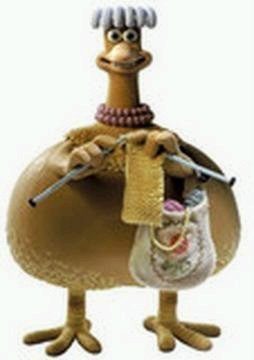
Do the Funky Chicken

It’s cold and snowy and about to get much, much colder and much, much snowier. So, like all chronic knitters, my fancy has turned to felting. I have two hats and one Secret Project in the laundry room awaiting felting. I couldn’t wait for messing with a felted something, though, because, for a person who makes things stitch by stitch, I have surprisingly little patience, so I found an old felting project from a previous arctic cold spell and decided to make use of it immediately.

It was a misbegotten attempt at a project bag, and I know exactly why it was so ugly and awful. I was trying to use up two ugly, awful yarns that I had acquired somehow, and I couldn’t think of what to do with them. One was a speckledy purple with some twiggy bits still in it, and the other was someone else’s first attempt at dying yarn – purple and green and splotches of white. I kept shoving them to the bottom of the theoretical project basket until finally I thought “striped felted bag” and cast on, knit like crazy until I was nearly out of each yarn, then I flung it in the washer over and over until I hated it enough to lose it in a laundry basket. I then brought it upstairs and lost it in my husband’s clutter for a year or so. It got moved around for another year, always at the bottom of some pile we didn’t want to deal with, but it escaped a week or two ago, and whispered, in its croaky, hoarse little green and purple voice, “do something with me”.

So, I decided to make a felted tea cozy out of the top half, and maybe use the bottom half for a smaller project bag. I cut 10 inches off the top of the bag, so that I wouldn’t back down and hide it again, and then browsed around on the net for ideas. I kind of figured I wanted a chicken cozy of some sort, but I was looking for a simple enough idea so that I could cut it out, sew it (I am sewing impaired), and make it look reasonably chickeny. I had some success, cut out a rough chicken shape, then realized it was going to need eyes, a beak, a comb, and probably a hanging loop. I crocheted everything but the eyes, and then I found two slightly stoned looking two-tone buttons in my sad little sewing basket, which would do for crazed chicken cozy eyes. Below is the result, which I am pleased to say, everyone one in the house immediately recognized as a chicken, however the follow-up question was, repeatedly, “Why is it purple and green?”


Should you become possessed by the need for a felted chicken cozy and have some unloved felted material around, my rough working outline was as follows:

1. Piece of felted knitting, 20 inches long by 10 inches high; fold in half for a 10 inch square; cut out general chicken shape

2. With about 6 yards of crochet kitchen cotton crochet a beak (ch8, sl 1, sc to end, cut and draw yarn though), a comb (c8, turn sl 1 in first st, in next st * 1 sc, 1 hdc, 1dc, 1hdc, in next stitch 1 sc *, repeat twice, end with sl st in last chain, bo) and a loop (ch 15)

3. Turn chicken inside out, sew from tail across back, inserting and sewing loop at midback (make sure it will hang out on the right side), sew to beginning of top of head, insert comb and do similarly, then about halfway down the chicken face, insert the stub of the beak and sew it in, then sew the chicken breast.

4. Turn right side out and display proudly to family. Fits fairly snugly over a 3-4 cup (or smaller) teapot.

And, it really, really keeps the tea warm. My first test drive included going off to do something else for 2 hours and coming back to tea still warm enough to be soothing and fragrant. If I were given a do-over, I’d make it a couple of inches wider, but it is just the right height.

Which leads me to my Secret Project – a Little Red Hen Cozy. Again, I have some unloved red yarn, and lots of it, in my stash. I’d already made a dog sweater for Gracie from it, as well as a hat awaiting felting for me, and there was still a bodacious amount of yarn left. I have done all the knitting on the LRHC, but I’m going to wait until it’s been felted before publishing. I should probably ‘fess up here and admit that I have a general chicken theme to my kitchen, which so far includes some pictures of cheeky roosters, a ceramic rooster, a wooden speckled hen, and some chicken dishtowels. And a chicken tea cozy now, too.

More Knits

I was sick with bronchitis for most of the holidays, but I can’t stand to have idle hands, so I made, as I mentioned in a previous post, another Feather and Fan Comfort Shawl.


It came out pretty nicely, too. The blues look much more differentiated in tone in person. The sequence is medium blue, marled blue (one strand each of dark, light and medium blue), and light blue, with dark blue in between each section and all around the border.

Oddball Word of the Day

ablation (ab-LAY-shehn): n. a wearing away, as of a glacier by erosion or the nose cone of a rocket by the heat to high-speed reentry into the atmosphere

(from the guide to MMMW edited by Laurence Urdang)

Thursday, December 11, 2008

Online Shopping for Older Gals

OK, some folks may object to the term “gals”. I beg your durn pardon. In my family, we use the term kindly, in the manner of “dames” – slang for women who liked to do fun things, hang out, and occasionally tell an earthy joke.

Nevertheless, we’re hard to shop for sometimes – we won’t tell you our clothing or shoe sizes, we generally have most of what we truly NEED to get through the day, and we have our own quirky tastes, about which we may have developed enough diplomacy to not hold forth with opinions full of clues. Generally, this leaves the well-intended gift giver with two options – a fruit/food basket or bath stuff.

Speaking as a middle-aged gal, I can buy my own fruit and food (although, in my heart of hearts, a modest fruit basket IS nice this time of year), and I have enough bath stuff to last well beyond my life expectancy. So, herein are some starting points and my personal favorites. All websites have been visited recently, ordered from within the last year, if not the last quarter, and shipments or emails have been prompt and polite.

Todd & Holland Tea Merchants : My knitting friend introduced me to their teas, teapots, and general wonderfulness. This is real store that has a delightful shop to visit, if you are ever in the area, and you’ll find that everyone is absolutely, positively nice as they can be. The website can be a tad hinky (if it looks like you’re getting a blank page, scroll allllll the way down), but you can make special requests or ask a question in the “comments”: box when you order, and they’ll call you back right away. They also ship like lightning -- I’ve ordered on a Tuesday and opened my box o’ tea on the very next Wednesday afternoon.

My highest recommendation goes to this tea tumbler which is a thermos for loose tea so you can take your tea with you. It’s great, and only $15.

As far as teas themselves (Teas are priced at their large sized packages. Request the sampler 0.05 lb or 0.12 lb sizes in the comments/special request box at checkout), I recommend: Jasmine Pearls (if you like the scent of Jasmine) , which is a delight for the senses, Northern Lights, a white tea with a wonderful spicy, warm aroma, perfect for chilly days, Goji Xing , a white tea with a mild melon flavor from the Goji berries, and Green Tea with Lemon and Hibiscus , which is very refreshing and light.

If you want to do something really fun and special, buy one of their glass teapots and a selection of Performance Teas . Performance teas are not to enhance your performance, they are small bundles of tea which you throw in a pot of hot water and watch them unfold into beautiful tea sculptures as they brew – which is why a glass pot is recommended. My daughter and I brew a pot of performance tea every Friday and do girl talk for a half an hour or so – it is a very nice experience and time for girl-type bonding, a good bargain at $2.50 per tea bundle.

Also, their Bee House teapots are a joy to use, not only because they are cute, but also because they are easy to clean. The lid pulls right off, the tea strainer basket lifts out, and it couldn’t be easier to tidy up when you’re done.

Faerie’s Finest : I don’t know about their other products, but their flavored sugar is great. I have tried the Citrus Burst and Raspberry Ripple and find them delightful. I sometimes like to use the Raspberry in my coffee, which makes it taste almost dessert-like, and you get good value for your money.

Bath and Bodyworks : Yes, I know what I said about bath stuff. They also have very nice socks and other textiles, and everyone I know uses their antibacterial hand sanitizers, and their antibacterial soaps are agreeable, too. I recommend the Kitchen Lemon for the soap – at $3 each, it’s a nice stocking stuffer, and it won’t make you smell like a pre-teen girl.

If your intended recipient likes wildlife, Whales and Friends has nice products. I have a penguin tote of very nice quality that I got as a gift from them.

For knitters, especially sock knitters, this year’s Patternworks has something new – sock yarn knitted into a scarf , then dyed in a funky pattern, and you knit FROM the scarf into a pair of socks. I’m hoping to get one of these this year.

Their “tools” section has all kinds of spiffy stuff, including Eucalan wool wash and a good chart holder. “Finishing touches” has nice shawl pins, clasps and purse handles.

And, finally, if you want something unique and beautiful that is not in any of the above categories, I recommend a good browse through the Art Institute of Chicago’s gift shop. I have found spectacular silk scarves, jewelry, bowls and other wonderful housewares there. Not cheap, but excellent quality and very memorable.

Happy shopping!

Oddball Word of the Day

boulevardier (BOOL-eh-var-DEER) n. a man-about-town who frequents fashionable places

(from the guide to MMMW edited by Laurence Urdang)

Wednesday, December 10, 2008

The Feather and Fan Comfort Shawl

I generally do not encourage, nor practice, any knitting for Christmas after Thanksgiving, unless it’s something I’m already familiar with and which would otherwise be a one or two day project. My main reason for not doing “Christmas knitting” is that the season is already so full of things to do, anxiety and chaos, that sticking a large project in there which must be done in time seems like a recipe for ruining my enjoyment of the season with unnecessary stress. That doesn’t mean that I stop knitting – I pick things that are basically mindless knitting, which I can do in front of the TV, and it’s nice if they look much more spiffy than their ease would imply.

One of these kinds of projects is the Feather and Fan Comfort Shawl designed by Sarah Bradberry, who has a wonderful website with lots of fun free knitting patterns, including this one for the shawl. This pattern is very rewarding for new or insecure knitters because it is easy to make and looks nice, and we “old hands” like it, too.

I’ve made it twice and am working on a third one. The first was made of oddments, looked nice, and I gave it away. This is the second one, made of Wool-Ease oddballs.


The one I’m working on now is in acrylic blues with a sparkle thread (I had a brain spasm) that I bought as a package from Herrschner’s online – Snow and Ice is the name of the color combination. I can tell you from past experience, this is one of the fastest shawls to make that I’ve done. I use needles sizes one larger than recommended for the yarn, which adds extra drape and emphasizes the lacy aspect.

The pattern is screamingly easy to memorize – it’s basically three rows of knit (giving two garter rows on the right side), then a row of knit, a row of purl and a row of knit with the easy doodly pattern, then start over.

When you print out the pattern, it seems daunting because it’s seven pages long. Three of those are pictures for the person who likes very specific visual guides. The remaining pages are double-spaced for clarity. It’s well written with no mistakes or typos (RAH, RAH, SIS-BOOM-BAH!), and the ONLY addition I would make is to add in four markers – one before and one after the feather and fan pattern on row 57 on each side.

I have two reasons for the markers. One, I like a tactile reminder to watch out for the center stitch when I’m aimlessly knitting along (the two center markers do that). The other reason is that the pattern repeats over 18 stitches, and if I want to make mine longer than the step-by-step instructions, adding markers helps me make sure I’ve built up a enough stitches to add in another two repeats. The pattern is certainly well written enough to not need them, if you prefer not.

So, I recommend making a Feather and Fan Comfort Shawl this Christmas, all the way through the holidays, and giving it to yourself when you are done because you won’t mind if it’s late or early or has a mistake in it somewhere (which only you can see, but if you’re like me, it’s the ONLY thing you can see for quite a while).

Wear it in the mornings when you’re having your early beverage, wear it at night when you stay up late to look at the tree, take it with you when you go out to get the mail and sling it around your head and shoulders like a giant scarf. Loan it to the kids as a mini-blanket while watching TV. Wear the daylights out of it and then make another one!

Oddball Word of the Day

stenophagous (stin-OFF-eh-gehs): adj. able to live on a narrow range of foodstuffs (sounds like teenagers)

(from the guide to MMMW edited by Laurence Urdang)

Monday, December 01, 2008

FREE Knitting Pattern - Welted Tea Cozy


Welted Tea Cozy
(No sew, knits up quickly, fits a wide variety of teapot shapes and sizes)


Supplies:
Probably 6 oz of scrap worsted - About 4 oz in light color, 2 oz in dark
One pair size 8 needles,
One set size 3 dpns

Finished measurement: unstretched 10 inches around, stretched 18-20, 6” high in welted area, top adds another 2” of height, 5” of I-cord (folds to 2.5”)

SIDE:
CAST ON 25 stitches with size 8 needles in lighter yarn.
Knit 6 rows in stockinette. Turn so back side (reverse stockinette) is facing you. This side of the lighter color knitting will become the outside (right side) of the cozy.
*Change to darker color without cutting lighter color and knit stockinette 4 rows.
Do not turn work yet.
Change back to lighter color, knit one row across, turn, knit 5 rows stockinette.*

(You should now have one sticky-out, bunched-up “welt” in the lighter color, one “welt” in the darker color sticking out in the opposite direction, and a third welt in the lighter color. The work is VERY stretchy. Use even numbers of rows of each color so that the color changes are all on one side.)

Repeat the rows between the asterisks above until you have 5 welts of each color, the last one being dark.

SPOUT OPENING:
In lighter color work first row as above, turn, work 2 rows stockinette.
Next row, knit 8, bind off 12, knit 5.
Next row purl 5, cast on 12, purl 8
Next row, knit 25.

Continue 2nd side as first side above, with 5 welts in each color, this time the last one is light colored.

HANDLE OPENING:
In darker color, knit 1 row stockinette.
Next row, purl 5, cast off 15, purl 5
Next row knit 5, cast on 15, knit 5
Next row, purl 25.

BIND OFF as follows:
Turn work inside out (dark welts protruding). Line up the original cast on side and the last row of the final dark welt. Slip the first stitch of dark, pick up the bottom of the corresponding cast on in light and slip that also. Knit both the next dark stitch and the bottom of the next corresponding light cast on stitch as if they were one, pass the two slipped stitches over. You now have one dark stitch on the working needle, the rest of the dark stitches on the holding needle, and the light edge is dangling.

Basically, what you are doing is a three-needle bind off without the third needle – the cast on stitches are being worked in as if they were on that third needle. If you are more comfortable with three needles, by all means, put the cast on stitches on one and continue binding off.

Bind off all stitches in this manner. You now have a cylinder with one shorter slit for the spout and one longer slit for the handle.


TOP:
With dpns pick up 64 stitches around the top. (I make the side with the color changes the top so I can just knit right over the side floats.) This will pull the work in slightly. If you prefer to pick up more stitches, it’s absolutely your choice, # of stitches is not critical, however they should be divisible by either 4 or 6.

Work 1 to 3 rounds even, your choice. I did one.

Begin swirling decrease:
(SKP, K14) four times (60 sts)
(SKP, K13) four times (56 sts)
etc. – knitting one less between SKPs each row until you are down to 4 sts.

Knit the 4 sts in I-cord for 5 inches, bind off, leave a 5-inch tail, pull through.
Weave tail tightly into inside of top.

VARIATIONS: If you want the top to be flatter, decrease by 6 sections (as opposed the four above). For absolutely flat tops, 8 sections should do the trick. Put one row of even knitting in between decrease rows for a wider top.

Feel free to use all one color, different welting variations, whatever.

I used a loop on top because that makes the cozy easy to remove, and I can hang it on a kitchen hook where it’s cute and up out of mess. The loop is not important otherwise.

Oddball Word of the Day

proceleusmatic (PROS-eh-loose-MAT-ik): adj. arousing to action or animation; putting life into; encouraging

(from MMMW, edited by Laurence Urdang)

Wednesday, October 29, 2008

Absent for Cause

My father passed away on October 17th after a long stay in the ICU of the local hospital. I have been dealing with the aftermath and final rites (and my sister) since then. I hope to return to a more active blogging state once I have finalized his estate matters.

I am both sorry and relieved that he is gone. I will miss my dear father, but I am not sorry that he is finally relieved of living with Alzheimer's in a body so frail and fragile that he could no longer sit upright, nor care for any of his own personal needs, nor had he been able to do so for several years.

My sister has been here for a month, and I have been very close to either sticking a fork in my own eye or in hers. I've settled for drinking a lot of green tea, smiling vacantly at her monologues, and telling myself I was doing it for Dad while, in the words of one of my favorite humor writers, Dave Barry, my brain snuck out of my cranium and went off to do something more interesting.

I wish any readers the best and give you my thanks for checking in. Don't give up. I'll probably need to vent (maniacal laughter) in a week or so.

God bless you.

Absent for Cause

My father passed away on October 17th after a long stay in the ICU of the local hospital. I have been dealing with the aftermath and final rites (and my sister) since then. I hope to return to a more active blogging state once I have finalized his estate matters.

I am both sorry and relieved that he is gone. I will miss my dear father, but I am not sorry that he is finally relieved of living with Alzheimer's in a body so frail and fragile that he could no longer sit upright, nor care for any of his own personal needs, nor had he been able to do so for several years.

My sister has been here for a month, and I have been very close to either sticking a fork in my own eye or in hers. I've settled for drinking a lot of green tea, smiling vacantly at her monologues, and telling myself I was doing it for Dad while, in the words of one of my favorite humor writers, Dave Barry, my brain snuck out of my cranium and went off to do something more interesting.

I wish any readers the best and give you my thanks for checking in. Don't give up. I'll probably need to vent (maniacal laughter) in a week or so.

God bless you.

Monday, August 25, 2008

Why Kids Don’t Read

I don’t have this problem. I introduced my kids to literature by reading to them a whole lot when they were babies and toddlers, and they were fascinated by the sound of the written word, the delightful illustrations in children’s books, and by having their imaginations stimulated. I can remember each of their first favorite books.

Spot’s favorite book was a cutout, cardboard book with beautifully illustrated pictures on how to get dressed. It was called Teddy Dresses. Teddy had a lot of trouble figuring out the difference between socks and mittens. Spot used to laugh and laugh at Teddy’s troubles, but I noticed he also took the book to bed with him sometimes and was very carefully (and correctly) clad the next day.

Bunny’s favorite book was the timeless Cat in the Hat. She was lulled by the rhythm of the words, and enthralled by the pictures. She pored over the pictures when I was too busy to read to her and memorized the placement of the disgruntled fish, Things One and Two, and the posture of the misbehaving cat in each drawing.

Doodle’s favorite was a freebie book we got either through a school program giveaway or from some other freebie source, back when giving away kid books was a big thing. It was called Snug Bug. Snug Bug was a mischievous little antennaed fellow who played in all kinds of people places and had to be tucked into bed by his bug mom. It was a good bedtime story; he invariably wanted to be tucked into bed just like Snug Bug.

They’ve all read their way through the Harry Potter (Doodle’s first grade teacher was a good egg – she liked that he was bringing “big, chapter books” to school because it sparked a competitive spirit in her other students and made them want to improve their reading skills, too) several times; they’ve read the Eragon books (and weren’t impressed); they’ve read stories by Isaac Asimov, Poul Anderson, Anne McCaffrey, Agatha Christie, Nancy Atherton, Stephen King, Meg Cabot, Frank Herbert, Janet Evanovich, Lincoln Child, Douglas Preston, Mercedes Lackey, C. J. Cherryh, Diane Duane, Larry Niven… The list of authors whose works they enjoy reading for pleasure is endless. They come by it honestly because I am a compulsive reader, and I’m pretty sure it’s contagious.

One thing these books all have in common is that they are fun to read, not because they are all silly, although some of them are, not because they are all adventure stories, although some of them are, but because they are written with social, emotional and intellectual skill. They don’t bludgeon the reader over the head with ham-fisted moralizing or coma-inducing manifestos on social ills; they allude to them, assume prior knowledge, or analogize, something which seems to escape learned and erudite literary critics, who frequently seem to assign science fiction, horror, suspense, cottage mysteries, and other forms of popular fiction the automatic label of “unworthy fluff”. What these critics seem to be missing is that it takes an open and agile mind to make a point without sticking that point painfully in the reader’s eye.

What writers whose books are frequently read for pleasure understand, it seems to me, is that people read during their leisure time because they want to go to a magic show, not church. We want to be entertained, enthralled, surprised, amazed, see something new, see a new twist on something old, see something through different eyes, and we want it to be easy to enjoy, we want the escapism inherent in becoming engrossed in a book to be smooth and deftly managed; we do not want to have The Point hammered through our “idiot” skulls like a railroad spike driven home with sledgehammer obviousness.

It’s not that common literary themes are not addressed in popular fiction, it is that they are not painted in such broad strokes that they obscure the art and magic of good writing. It is as easy to understand racism from reading Asimov’s Caliban as it is from reading To Kill a Mockingbird. One is considered “classic literature”, but the other is dismissed as “only science fiction”. The former draws the reader into a world which has not yet existed, requires no additional research, whereas the latter requires the reader to learn more about a specific time period with which they may not be familiar, in order to understand The Point. Which one do you think kids would enjoy reading more?

I have yet to figure out why writing a five-page paper on the literary themes in The Good Earth or To Kill A Mockingbird is considered of greater intellectual worth than doing the same from an examination of The Mote in God’s Eye or The Dragonriders of Pern. The intellectual work is more sophisticated with the sci-fi and fantasy books because The Points are subtler. I do understand that it would not be in accordance with a standard expectation of having read “the classics”. I would argue that “the classics” need some amending. It’s not wrong to think outside the paradigm, which is, in fact, something we’d like to encourage in our children.

And, I’m not alone in my thoughts. An article by a private school English teacher in Sunday’s Washington Post, entitled “We’re Teaching Books That Don’t Stack Up” makes this argument, to some extent, as well.

Way back in the Jurassic, when I was a freshman in college, I took an introductory English class. The grad student teaching the class would habitually put a quotation on the board from some literary work – not all were from standard classics. He’d ask if anyone was familiar with the quotation, and my spring-loaded arm would shoot into the air. After a week of this, and the usual skills assessment first paper, the teacher had me come in to his office, and a few other teaching assistants and a professor or two and I conversed in a general manner while I was waiting for my TA to explain why I was there.

It turned out that he was getting departmental permission for me to go on independent study. I’ve written about this before , but what I haven’t said is that I wrote my research papers on science fiction short stories. It wasn’t a problem either; it was a joy, and it was a joy to me because I didn’t have to hack my way through archaic English, characters that didn’t interest me, situations that were insipid, painfully historical, or drenched in one or another overpowering Points. I got to read what I wanted to read, but I had to make good on that by using the skills of good literary analysis. What I read wasn’t important, how I read it was.

I suppose I didn’t understand at the time how unusual that permission and resultant independent study was in the context of English studies. I retroactively applaud that TA, and the English department professors, for being astute enough to understand what the real Point of studying literature is – to enjoy the magic show while being able to unravel the magician’s tricks right down to the equipment, props, and the foundations of the stage itself. But it all starts with the lure of the show, doesn’t it?

I sent my daughter, who is majoring in English, a link to the article referenced above. Here’s her response:

“Thanks, Mom! That was really interesting. I can totally identify with this article, too. When we read The Scarlet Letter junior year, I automatically geared myself to hate it due to past experience, and therefore failed to enjoy what I now realize was actually a really good book. So much of what we have to read for school is obviously good literature, but they make it horrible by dragging us through it by reading aloud and mixing it in with so much depressing literature that we can't identify the great works anymore. I realize now that Great Expectations really wasn't that bad, but since I went into it EXPECTING to hate it, that's exactly what happened.”

Ahem.

Oddball Word of the Day

appetence (AP-eh-tehns): n. intense natural desire; craving

(from the guide to MMMW edited by Laurence Urdang)

Friday, August 22, 2008

SpEd Tip #2: Keep Your Documents…and In Order

One of the first things I have my clients do is round up all their documents regarding their child – medical records, specialist records, school records, notes from teachers, standardized test results, etc. I ask them to put them in reverse chronological order, with the earliest documents on the bottom and the most recent on the top.

There is a very good reason for doing this – it creates an excellent way for me, and for the client, to review their child’s educational history and how medical diagnoses and treatments affect their educational progress. We can each read through the file, or stack, or mountain, as the case may be, from bottom to top, and get a pretty comprehensive understanding of how the child has arrived at the point where the parent is seeking special education services, and my services as well.

We can see what the school has done, if anything, over time, which teachers were on the ball and which weren’t, and we sometimes, speaking as a parent, find out that we have fallen short from time to time as well. Having the documents arranged and collected in this manner is a real eye-opener.

This also helps highlight which documents are missing, and there will be some gaps. One of the things I do, early in my relationship with the client, is a document review. I check to see if there is a full set of grades, standardized test results, documentation supporting any special ed services, and so forth. There is very rarely a complete set, and that’s absolutely normal.

When that happens, it’s important to fill in the blanks by sending the school a FERPA letter. Further information on what FERPA means and what should be in the school records is here . Here is a sample FERPA letter, which can be altered to fit the child’s specific information:

Your Name
Your Address
City, State, Zip
Home Phone

Date

Mr. , Principal
UNCOOPERATIVE SCHOOL
Street Address
City, State, zip

Re: Name of student

Dear (Principal):

As you are aware, my child is a student at Uncooperative School (or “has been found eligible for special education and related services and currently has an IEP”). In order for me to have a clearer picture of my child’s educational history, please either make available for review and photocopying or send me a complete copy of my son’s entire cumulative and confidential records.

Please be sure to include copies of all evaluations and actual test scores, any electronic communications, computer records or records stored on other media, and any personally identifiable records regarding my child. If there is a cost and policy about photocopies, please let me know immediately.

If you have questions about my request, please contact me at the number listed above.
Thank you for your assistance and quick response.

Sincerely,


, parent

Cc: Name of, Lay Advocate
Name of, Special Ed Director

This letter must be signed by the parent, and it’s important to follow up on it. Usually the school will make copies and have the parent come in and get them. Sometimes they will only make them available and the parent has to come in and review the file and ask for specific copies. Other times they may refuse to make copies, and the parent should bring a camera or hand scanner and get copies that way.

It is often the case that the first letter does not do the job. Some records may have been sent off to the regional office of education, some records are purged annually and are no longer available, and very often schools do not include the emails which mention your child. In that case, I follow up with FERPA letters to the special ed folks, the regional office of ed., and a letter to the school which mentions missing documents and asks for a further search (and copies) or which nicely asks where these items might be.

Schools will not admit to having lost documents, and are often snarky enough to ignore the letter requesting additional or missing documents. It doesn’t matter – if you’ve sent a written request for the documents and/or an explanation, you have behaved reasonably and entered YOUR LETTER into the record. If you don’t get a response within 10 days, send a photocopy, clearly marked SECOND REQUEST (and add the second request date) all in red at the top in large print.

It can sometimes take six months before you can be sure you have exhausted every possible location where a document might be stored and before you are sure you have a comprehensive list of what’s still missing. That’s normal, too. Generally, the first two letters (first FERPA and first follow up) will unearth enough information to make it possible to move forward with reasonable accuracy and efficiency.

Keep copies of all the letters and emails you send, too. This saves time in finding addresses and contacts, and makes your records the best available should legal action become necessary down the road.

This dogged pursuit of every possible document relating to your child is the most valuable thing parents can do to assist themselves, their advocate, or their attorney in getting appropriate and timely services for a disabled child. There is a real wealth of information in longitudinal educational data – charts and graphs can be made showing lack of progress, decreasing scores over time, pinpoint areas of particular concern, show a puzzling relationship between class grades and standardized scores, and so on.

I have used this kind of information with consistent success and gotten real insight into the clients’ children, finding out things they haven't noticed in the face of more obvious problems. Visual presentations of data are winners in meetings, too – it’s hard for the school district to argue with their own data showing steadily decreasing abilities and scores. They don’t do this kind of reporting or analysis, but you should (or your advocate or other helper).

Your stack of paper will become pretty large, and lots of people are surprised by the eventual size of it. Make a copy of everything, put the originals away safely, and then keep the copies, in the order mentioned before, in a big, sturdy, three-ring binder with a divider for each year. Particularly important documents can be tagged with bright sticky notes so that you can find them easily in order to refer to them. You want copies, not originals, in your “working notebook” because you must not punch holes or make marks on your original documents, if at all possible – that’s why you store those elsewhere.

Bring your big, scary binder to each meeting until you have an IEP or 504 that you think is appropriate and complete. Over time, and with successful interactions with your school district, you will be able to retire the early information, since you won’t need to refer to it much. You can reduce your working binder to this year’s and the preceding year’s information, PLUS the complete set of standardized and special ed domain tests (and your visuals) and grades (and visuals). Remember, this is ALL current information to and from the school district and education personnel – your emails and letters, doctors’ note or letters, etc.

Do not, under any circumstances, give in to the urge to purge until your child has graduated high school, or if they have extended services to age 21, until those services expire. I guarantee you that you will never regret having collected, analyzed, and kept all this information.

Oddball Word of the Day

slumgullion (slum-GUL-yuhn): noun 1. a dish of stewed meat and vegetables, 2. any weak, watered-down soup or beverage

(from the guide to MMMW edited by Laurence Urdang)

German Idiom for Friday

die Karre aus dem Dreck ziehen (colloquial): to put things right, to sort things out

zB: Mein Arbeitskollege ist wirklich unzuverlaessig. Wenn er etwas verpfuscht, muss immer ich die Karre aus dem Dreck ziehen.

auf Englisch: My workmate is really unreliable. When he bungles something I'm always the one who has to sort things out.

(from the guide to German Idioms by JP Lupson)